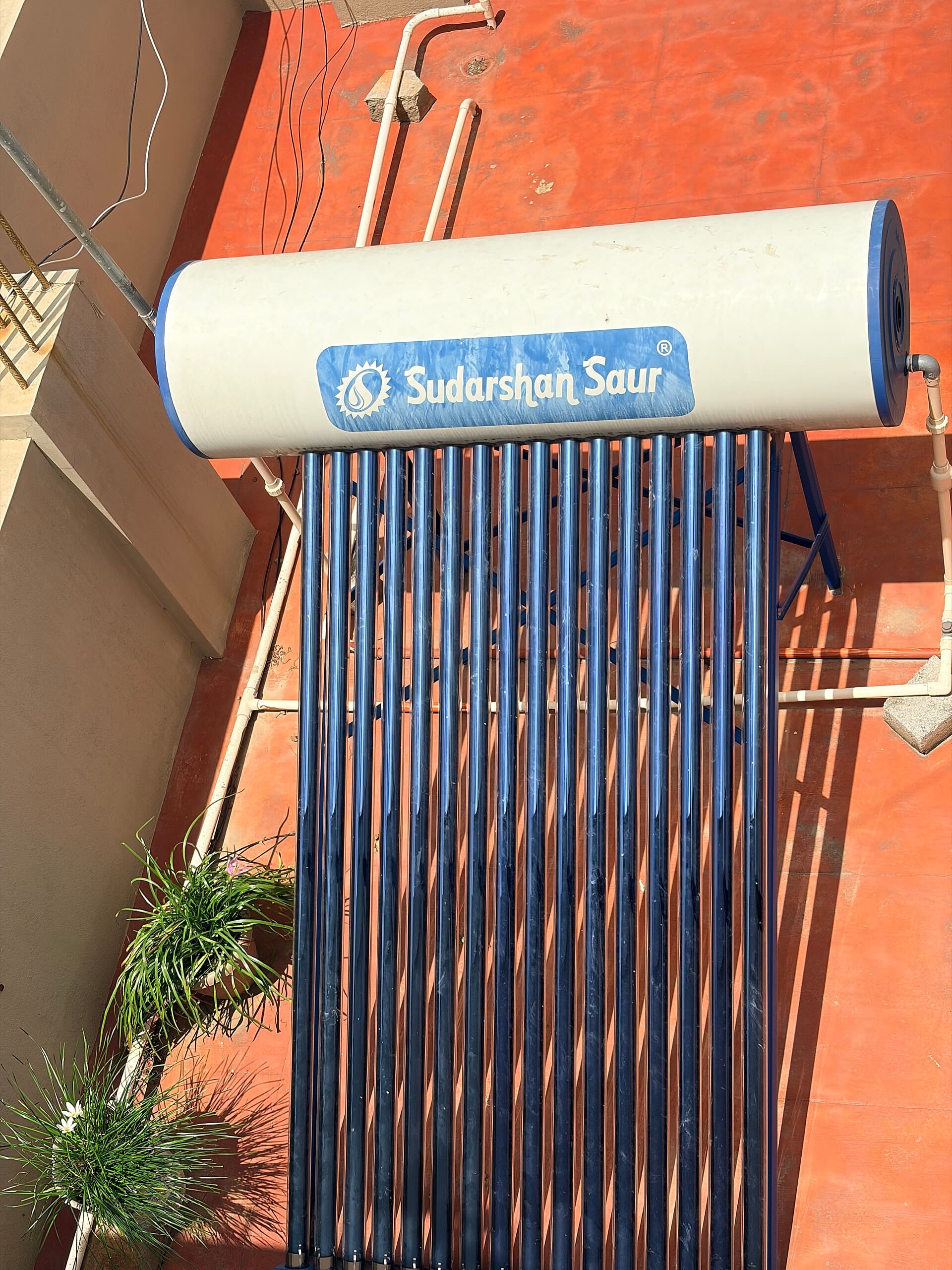
Buying a water heater in Nigeria usually starts with the shop asking how many people use the bathroom, then quoting litres. It should start with a number of kilowatt hours. Heating 200 litres by 40 degrees takes about 9 kWh, more than most families use for lighting in a week. Once you see that figure, solar water heater sizing stops being a matter of taste and becomes arithmetic you can check on the back of an envelope.
Solar water heater sizing starts with litres, not watts
There are two families of product and they are confused constantly. A storage heater holds hot water in a tank, heated by an element inside. An instantaneous heater has no tank and produces hot water as you use it. Almost everything sold as a solar water heater in Nigeria is a storage heater with an element, and everything below applies to that type.
The sizing questions are three. How many litres do you use. How many degrees above incoming water you need. And how long the element is allowed to take. Get those three and the element power follows. Ignore them and you will either buy a tank that runs cold or an element that trips the inverter. Every good solar water heater sizing conversation starts here, not with a model number.
The physics that sets the element rating
Heating water needs energy, and the amount is the mass multiplied by a constant for water and by the temperature rise. One kilogram of water needs about 4.2 kilojoules to rise one degree, and a litre is roughly a kilogram. A 200 litre tank raised 40 degrees therefore needs 200 times 4.2 times 40, which is 33,600 kilojoules, and dividing by 3,600 gives 9.3 kilowatt hours. Allow a tenth for tank and pipe losses and you are at 10 kWh per full heat.
That explains most disappointments. People see a 3 kW element and assume hot water in twenty minutes. It is closer to three hours, and the fact that the shower lasts seven minutes does not help, because the tank must be full of hot water before there is anything to draw on. The specific heat capacity of water is why hot water looks expensive.
As a working rule, one kilowatt of element will heat roughly 15 to 20 litres through a 40 degree rise in an hour. Multiply that by your tank volume to get the time you need, and choose an element that fits the time you actually have. This is the only part of solar water heater sizing that needs a stopwatch, and you can do it at the counter.
| Tank volume | Energy for a 40 degree rise | 2 kW element | 3 kW element | 4.5 kW element |
|---|---|---|---|---|
| 100 litres | 4.7 kWh | 2.3 hours | 1.6 hours | 1.0 hour |
| 150 litres | 7.0 kWh | 3.5 hours | 2.3 hours | 1.6 hours |
| 200 litres | 9.3 kWh | 4.7 hours | 3.1 hours | 2.1 hours |
| 250 litres | 11.7 kWh | 5.8 hours | 3.9 hours | 2.6 hours |
Times assume no losses. Add about ten per cent in practice, and an element sized to reheat a full tank in under two hours needs a dedicated circuit.
Cold-water mixing is why a small element is enough
Here is the point that changes the whole design. Nobody bathes in 60 degree water. Every shower and basin mixes hot with cold at the tap until the result is comfortable, in Nigeria usually near body temperature. So the tank does not have to be delivered at 60 degrees to produce a comfortable 38 degree shower. It has to be delivered hot enough to survive the mixing.
That single fact decouples the element from the shower. A shower at 8 litres a minute with a 40 degree rise needs about 22 kW at the moment of use, which is why instantaneous heaters demand a large supply and often a three-phase connection. The same shower fed from a tank needs only an element big enough to put that heat into the tank beforehand, at 2 or 3 kW, because the tank is a buffer. Solar water heaters have been built around that buffer principle for decades.
The consequence for sizing is real. A 2 kW element serving a 150 litre tank can supply a household whose showers total 20 litres a minute for short bursts, because the tank refills between uses rather than during them. The limitation is recovery rate: three showers back to back will exhaust a tank heated slowly. If that is your pattern, buy a bigger element or a bigger tank, not a bigger pump. Sizing the storage and sizing the element are therefore the same decision, not two.
Storage volume, household size and the thermostat
Volume is about how many people want hot water at once, not how much they use in a day. Two or three people are usually well served by 100 to 150 litres, a family of four or five by 200 to 250 litres. A tank that is too large is not free: more litres means more standing heat loss hourly and more surface to insulate. A tank that is too small is more common, showing up as the third shower being cold. This is where solar water heater sizing becomes a question about people rather than litres.
Set the thermostat sensibly. Well above 60 degrees, scale builds quickly and heat loss rises; well below 45, you store water in the range where waterborne bacteria multiply, which is why health guidance discourages long storage there. Something around 55 to 60 degrees, with the mixing valve doing the rest at the tap, is the sensible compromise. The thermostat also protects the tank from the two failures that matter most, a dry element firing and a stuck control.
Do not underestimate how much the thermostat is doing. An element cycling through the night, reheating a tank nobody is using, wastes a surprising share of the energy. A timer that locks the element out between midnight and five, plus a well insulated tank, cost very little and recover much of it.
Heat loss is where the money quietly disappears
A storage heater is an energy store with a slow leak. The loss is governed by the insulation, the surface area, and the temperature difference between the water and the room, and it happens whether anyone uses the water or not. This is ordinary heat transfer, and the consequence is that a cheap tank with thin insulation can lose several times what a properly insulated one does over a day left hot.
Two things follow for sizing. Ask what the tank is insulated with and how thick it is, not just the capacity. And do not put the tank in a hot roof space with a long pipe run. A heat pump water heater sidesteps the fuel question but not the storage question, and some Nigerian buyers import one for the running costs. Storage also gives you something a direct element cannot: hot water through an outage. A tank full before the lights go means warm water for the first hours of the evening whatever the battery is doing, which in a country with unreliable grid supply is worth real money.
Elements, anodes and Nigerian water conditions
Two failure modes account for most repairs, and both are avoidable. The first is scale. Hard water, common in borehole supplies across much of Nigeria, deposits calcium and magnesium on the element sheath. Scale is a thermal insulator, so the element runs hotter, the deposit grows faster, and the element eventually burns out. Only a softener or a scale resistant element will prevent that.
Ask what the element sheath is made of, and whether the tank has a replaceable anode. An electric heater element in a steel tank needs a sacrificial anode to protect the tank wall, and the anode should be inspectable rather than welded in. The second failure is simpler: running the element dry. A thermostat that fails closed will cook an element in minutes, so fit a cut-out device that opens on over-temperature, close to the tank. Installation and wiring safety covers the protection side of the job.
Frequently asked questions
What size element do I need for a 200 litre tank?
Raising 200 litres by 40 degrees takes about 9.3 kWh, so a 3 kW element takes a little over three hours and a 4.5 kW element a little over two. Choose 3 kW if you are happy to recover overnight, and 4.5 kW for a quicker turn round or a large family. Check that the supply circuit, and the inverter if the element is solar fed, can carry the full element rating.
Is an instantaneous heater better than a storage tank?
For a large household using a lot of water at once, an instantaneous unit gives endless hot water but needs an output in the region of 20 kW, which usually means a three-phase supply and a large dedicated cable. For most Nigerian homes a storage tank with a modest element is cheaper, easier to install and more tolerant of a weak or intermittent supply.
Can I run the heater element from my solar system?
Yes, but be careful where you take the power. A 3 kW element on a 48 V bank draws about 62 A, the largest single load in most homes, and it dominates the battery. Better is a small dedicated array and charge controller feeding the tank by day, so water is hot by evening and the battery is never asked. 24 V against 48 V systems covers the current arithmetic.
Key Takeaways
- Work out kilowatt hours first. Heating 200 litres by 40 degrees costs about 9.3 kWh.
- A 2 or 3 kW element is enough for most homes, because the tank buffers the shower.
- Choose the tank for how many people want water at once, not for daily consumption.
- Insulation decides your standing losses, and a hot roof space is the worst place for a tank.
- Hard borehole water kills elements. Ask about the sheath, the anode and a cut-out device.
- A tank heated before sunset gives hot water through the first hours of an outage.
Heating water is one of the easiest loads to shift into the middle of the day, and building a solar load list is where that decision belongs, because it changes the array and the bank at once. A water heater sized without that thought ends up draining the battery at nine in the evening instead of running on sun.
Sources: solar water heaters, storage and instantaneous types; the specific heat capacity of water; heat transfer through a tank wall; thermostats and over-temperature cut-outs; electric heater elements and their sheaths; heat pump water heaters.


0 Comments