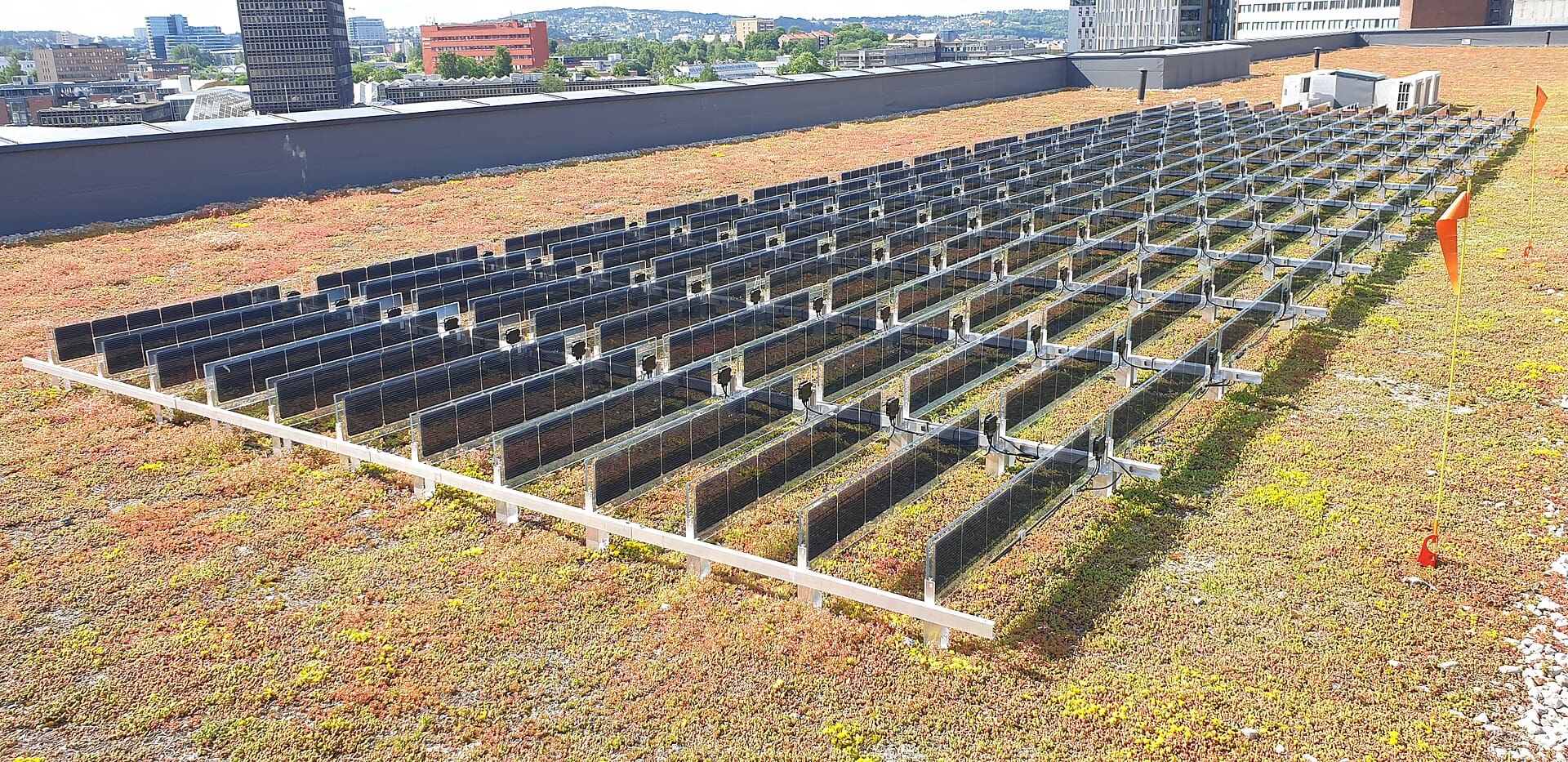
The pitch for two-sided modules is easy to sell. The panel collects light on the front and light bounced up from the ground on the back, so you get more energy from the same roof area. It is true, and the gain is entirely a function of what is behind the panel. Laid flat on a roof with a dark waterproofing membrane behind it, a two-sided module is a two-sided module that collects almost nothing extra, and you have paid for the privilege.
So the honest question is not whether bifacial solar panels work. It is how much they add at your site, and the answer is determined by three things: the surface behind the array, the gap under it, and whether anything shades the back.
Do bifacial solar panels really produce more?
Yes, on the front principle. A conventional module has an active front and an inactive back, usually a white or black polymer sheet that reflects a little light away. A two-sided module has cells or thin-film layers working on both faces, so any irradiance reaching the rear is converted rather than wasted. The gain appears as extra energy at the bottom of the day, when the sun is low and the front is receiving light at a glancing angle while the ground is still brightly lit. The rear response is weaker than the front, and the ratio of rear efficiency to front efficiency under the same irradiance has its own name, the bifaciality factor. The ground albedo, that bifaciality factor and the installation geometry together determine how large the boost actually is.
Two-sided technology was first produced in the late nineteen-seventies, became mainstream during the twenty-tens, and is now common in utility arrays. It works the same way on a small residential roof, with less room for light to reach the rear.
Albedo decides how much you get
Albedo is simply the reflectivity of the surface behind the array. Light hits the ground, part of it scatters back upwards, and the rear of the module collects it. A field study that measured a two-sided and a one-sided module over a year on different surfaces found rear irradiance gains above thirty per cent over white tiles and white gravel, above twenty per cent over concrete, and only five to ten per cent over soil.
| Surface behind the array | Approximate albedo | Measured gain |
|---|---|---|
| White tile or painted surface | 0.7 to 0.8 | Above 30 per cent |
| White gravel | 0.5 to 0.6 | Above 30 per cent |
| Poured concrete | 0.3 to 0.35 | Above 20 per cent |
| Dry soil or vegetation | 0.1 to 0.15 | 5 to 10 per cent |
| Dark roof membrane, panel flat against it | Very low, and almost no rear view | Effectively nothing |
That last row is the one that matters commercially, and it is why a reliable source puts the benefit plainly: where additional irradiance on the rear side is lacking, as with panels mounted parallel to a roof, bifaciality does not provide additional yield. In other words, two-sided panels laid flat on a dark membrane are an expensive way to own one-sided panels.
There is a second factor easy to miss. If you plan to raise the gain with a reflective ground strip or white underlay, that surface has to stay reflective. The same study found reflectance falling measurably as dust settled, which in Nigeria means a white membrane cleaned as often as the glass.
Height, tilt and spacing
The rear of the module can only see the ground if the ground is visible from the back. Mount the array flat and the back sees nothing. Raise it and the geometry opens up, and the same study found the irradiance gain between a half-metre and a one-metre mounting height differed by under five percentage points, with the gain continuing to increase beyond half a metre but levelling off, so that past a metre the extra structure buys very little extra energy. For that reason the commercial practice that has settled is a mounting height of roughly half a metre to a metre.
Tilt follows the same logic. A module further off the horizontal has a clearer view of the ground behind it and collects more rear light, so a steeper tilt generally helps the rear side, the opposite of what a front-side design would suggest. The trade-off is front-side yield at midday, so both effects have to be weighed.
Spacing matters for the same reason, and harder. If the row in front is too close, the next row shades the rear of the row behind it, and you have paid for two-sided modules and blocked the very thing you bought them for. On a compact urban plot, shading from a neighbouring building, a wall or a water tank can do the same thing. Any layout for two-sided modules has to be checked for rear shading, not just front shading, and that check belongs in the design rather than in the commissioning day.
Reading the ratings honestly
Ask for the datasheet and look for two separate things. The first is the front-side rating, which is the familiar power in watts, and the second is the rear-side rating, or bifacial gain, quoted as a percentage of the front. Some suppliers state a generous rear rating measured under ideal white-reflector test conditions. Measured against that, field results are smaller, and the same study noted that when gains are normalised by the manufacturer front-side rating the improvement is about five points higher than when measured against actual output.
Then ask how the module is installed. A two-sided module is usually a glass-glass build, which is more resistant to moisture ingress and to degradation than a single-glass module with a polymer backsheet, and that is a genuine long-term benefit independent of the rear gain. It is also the reason to expect the same rear performance for twenty-five years rather than for the first two, which is worth more than a few per cent of extra first-year energy. solar panel degradation covers what the long-term rate actually looks like.
Finally, check the inverter and the wiring. Most two-sided modules are wired as one string with an internal connection between the two halves, so the array looks electrically the same as a conventional one, and a single tracker can work. If your design separates the two faces into independent inputs, as some dual-port equipment does, each side needs its own tracker, and the two faces can be optimised separately. Know which you are buying before the installer orders the inverter.
Where it does not pay
Flat on a dark roof, expect nothing. Against a wall, expect nothing, because the back faces a dark vertical surface. Under a carport with packed earth below, expect very little. In a tightly packed row in a dusty city, expect a few per cent, which may not cover the price difference between two-sided and one-sided panels of the same brand.
There is a case that does pay, and it is not a roof case. Mounted above the ground on a stand, over a pale surface, or over light gravel, two-sided modules are among the better choices available, and the measured gains in that configuration are large enough to matter. bifacial solar panels are therefore worth discussing with your installer as a site-specific choice, not a default upgrade.
One more honest correction. Two-sided modules do not produce more power at midday. They produce more energy across the day, weighted towards the early morning and late afternoon, which is a better match for household demand than the midday spike. If your real problem is that the inverter is too large for the noon peak, solar inverter types is a more useful conversation than a rear-side upgrade.
Frequently asked questions
How much more do bifacial solar panels produce?
Anywhere from almost nothing to over thirty per cent, set by the surface behind the array. Measured field work found above thirty per cent over white tile or gravel, above twenty per cent over concrete, and five to ten per cent over soil. Nobody should quote one figure without asking what sits under the panels.
Do bifacial panels work on a rooftop?
Only if the rear can see a bright surface. Panels mounted flat on a roof membrane gain nothing, because there is no rear view. Mounted on a tilted frame above a pale parapet or reflective underlay, they gain something. Ask to see the rear-side view of the specific layout before accepting the claim.
Do I need a special inverter for bifacial panels?
Usually not. Most two-sided modules present a single string to the inverter, so an ordinary maximising tracker works. Designs that split the two faces into separate inputs need a dual-port inverter with a tracker per face, which is worth confirming at the design stage because it changes the equipment list and the price.
How high should I mount bifacial panels?
Roughly half a metre to a metre above the surface. That range captures most of the gain, and the measured improvement beyond one metre is small while the structure keeps getting dearer. Panels on a stand also shed dust better than panels lying flat, which matters in the dry season.
Key Takeaways
- The rear side is real, and the gain is set by the reflectivity of the surface behind the array, not by the module.
- Measured gains run from five to ten per cent over soil to above thirty per cent over white tile or gravel.
- Flat on a dark roof membrane, a two-sided module gains nothing and is an expensive one-sided module.
- Mounting height of half a metre to a metre captures most of the benefit; beyond that the steel costs more than it earns.
- Check rear shading from the row in front, the parapet or the tank, which is the mistake that quietly kills the gain.
- The extra energy arrives in the morning and late afternoon, which suits household demand better than a noon peak.
The module and mounting choices interact, so the panel and structure decisions are worth reading alongside half-cut solar cells and how many solar panels you actually need.
Sources: bifacial solar cells, the definition of the bifaciality factor, the role of ground albedo and the note that parallel-to-roof mounting gives no additional yield; measured comparison of bifacial and monofacial output over white tile, white gravel, concrete and soil, with albedo values and the effect of mounting height; albedo, the reflectivity of a surface and how it varies with wavelength and angle.


0 Comments