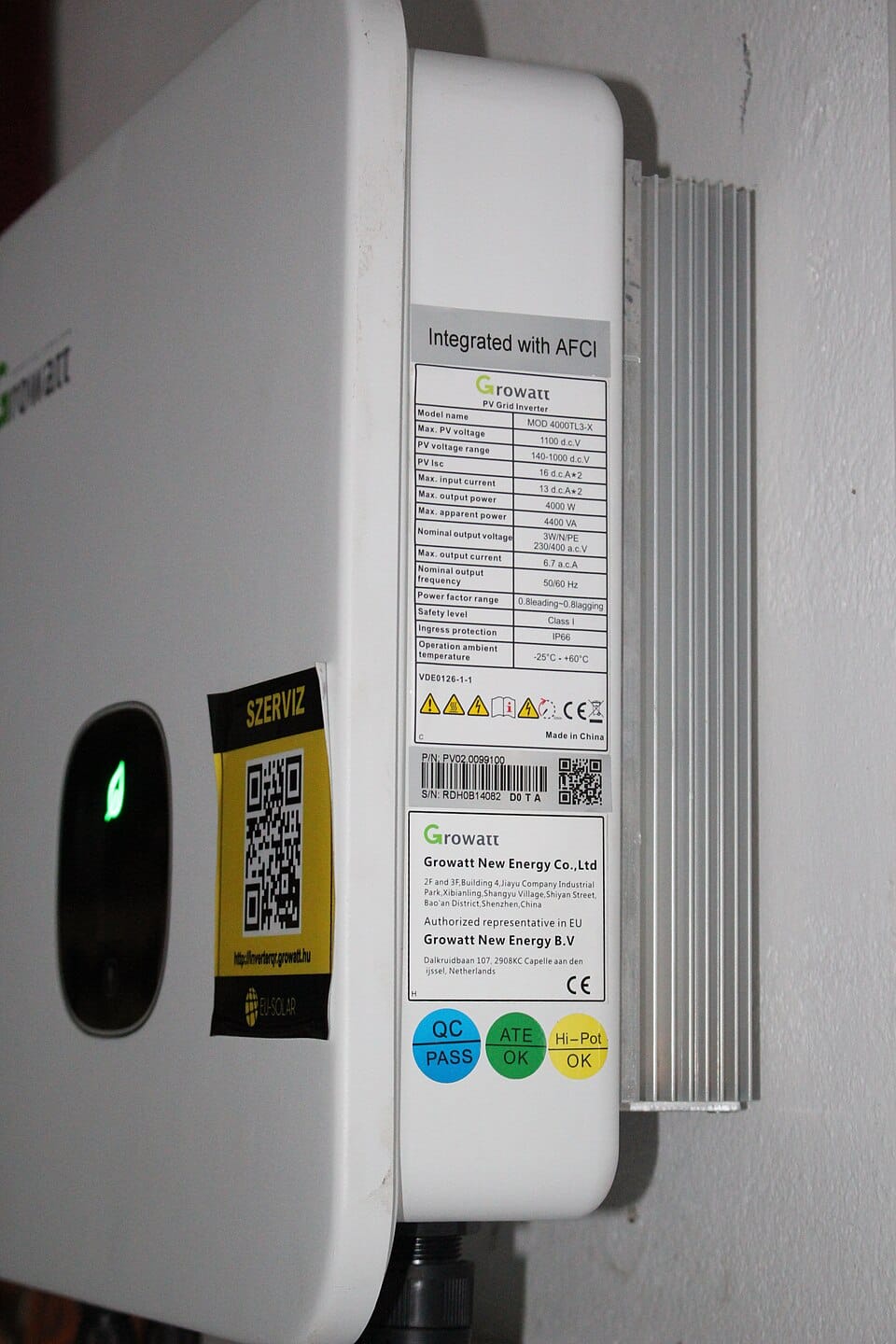
A 5 kW solar installation can be built around solar inverter types that behave completely differently at 7pm when the distribution company cuts supply. Most Nigerian buyers never see that decision being made, because it is made at the point of sale, by whoever quoted the job. Understanding the solar inverter types before you accept the quote is the cheapest insurance available to a solar buyer.
Solar inverter types are two lists, not one
The product name is unreliable, because retailers mix two separate questions. What does this unit do when the grid fails, and how does it find the best operating point on the array? Those are independent decisions, and one product can answer them differently. Separate them and the confusing range of product names collapses into a few real configurations.
The first question gives the three solar inverter types most people mean: the off-grid unit that ignores the grid, the hybrid unit that treats the grid as a third source and keeps a bank, and the grid-tied unit that uses the grid as its reference. The second question is the tracking architecture, which decides whether one maximum power point tracker serves the whole array or each module gets its own.
| Types of configuration | During a grid outage | Battery needed | Best fit |
|---|---|---|---|
| Off-grid or stand-alone | Unaffected, the grid is not part of the design | Yes, and the bank is the main cost | Sites with no reliable connection, or a wish to be independent |
| Hybrid | Takes over the house from the bank within a few tens of milliseconds | Yes, but a smaller bank is workable | Most Nigerian homes, where outages are frequent and grid quality is poor |
| Grid-tied | Shuts down, by design, to protect line workers | No | Premises with a stable connection and a workable export arrangement |
| Grid-tied with backup, or hybrid with optimisers | Depends on the unit | Usually yes | Large arrays where shade or module mismatch is the limit |
What a solar inverter actually does covers the conversion and protection jobs in more depth. This article is about choosing between the solar inverter types above.
Off-grid and stand-alone inverters
When the original configuration still makes sense
A stand-alone inverter has no meaningful relationship with the distribution company. The array charges a bank through a controller, the inverter draws from the bank, and every watt used after dark comes out of stored energy. There is no second source, which is both its strength and its bill.
Because the bank must cover the whole night, off-grid designs are dominated by battery cost. A household drawing 8 kWh after sunset needs a bank that delivers 8 kWh usefully, and the usable figure sits well below the label figure, for reasons set out in our guide to solar battery storage. The array must then refill that bank, so it is sized against the worst stretch of the wet season, not the average day.
Hybrid inverters and what happens in an outage
A hybrid inverter has three live connections: the array, the bank and the grid, and it decides moment by moment where the power comes from and where the surplus goes. In daylight, with a partly discharged bank and a house drawing less than the array produces, the sensible behaviour is to serve the house directly and send the remainder to the bank. That matters because pushing daytime solar through a bank costs energy twice, once in and once out.
When the grid fails, the same unit changes role within milliseconds. It disconnects from the utility supply and becomes the house’s only source, drawing on the bank. This is the behaviour Nigerian households are really buying, and it is why the hybrid type has become the default. Of the three types above, hybrid is also the one whose build quality varies most from supplier to supplier, which is why the datasheet matters more than the badge.
Not all hybrid units are equal, and they usually fail in one of two ways. A long transfer time makes the lights blink off and on at every outage, which convinces people the system is faulty. A charge profile set too aggressively drives the bank hard and shortens its life, particularly in heat. Ask for the transfer time in milliseconds and the absorption and float voltages the unit will use, then check them against your bank. Smart monitoring on inverters covers why a readable fault log matters at 10pm.
Grid-tied inverters and why they switch themselves off
A grid-tied inverter does one job well. It takes energy from a large, perfectly regulated source, converts it and pushes it back. Because the grid dictates the voltage and frequency, accuracy is very high and the unit can be small and cheap for the power it handles.
The behaviour that surprises people is that these units shut down when the grid fails, and it is deliberate. An inverter that kept energising a dead circuit could electrocute anyone sent to repair a downed line. Disconnecting quickly is the standard anti-islanding protection, and a compliant unit will not restart until the grid has been stable for a set period. For a Nigerian household that behaviour is disqualifying, and the full comparison sits in off-grid versus hybrid versus grid-tied.
String, microinverter or module-level tracking
The second axis decides how the array is read. A string inverter has one tracker for a whole string, so every panel in it runs at the same current. Because panels are not identical, and because a shaded or dirty panel drags the others, one weak module reduces the output of the whole string.
These tracking types are a separate decision from the grid types, and they mix freely: a hybrid unit can sit behind a string with optimisers on the shaded panels.
A microinverter puts a small inverter behind each module so every panel finds its own point independently, at the cost of more units, more cable and more housings to fail. An optimiser sits between the two: fitted to individual modules, it tracks and converts at module level while the main unit handles the output. Whichever you choose, the lesson is the same: shade, soiling and manufacturing spread hurt you more the more modules share one tracker. Half-cut cell designs reduce the penalty without removing it.
Matching the inverter to array voltage and bank
Two numbers have to line up or none of it works. The first is the array voltage window. Every string inverter and controller states the minimum and maximum direct current voltage it accepts, and the string open-circuit voltage at the coldest morning your site can see must sit inside that window with margin. The second is the battery voltage, because the unit is built for a nominal voltage, typically 24 or 48 volts. The reasoning is in 24 versus 48 volt systems.
A common and expensive Nigerian error is to put modern high-wattage panels on a unit with a narrow input window. Their open-circuit voltage is high, a cold morning pushes it higher, and a string that looks fine on a warm afternoon can exceed the limit before sunrise. Ask for the calculated string voltage including the cold correction, not the nameplate alone. The relevant rows of a datasheet are explained in how to read a solar panel datasheet.
Inverter types also differ in how much input headroom they allow before the array voltage window is exceeded, which is worth reading rather than assuming. The second mismatch is sizing. An inverter sized well below the running load trips every time a compressor starts, and repeated tripping is wear rather than inconvenience. One sized far above the load costs money and sits idle. The arithmetic, including the surge headroom a fridge or a pump demands, is in how to size a solar inverter and battery bank. Where the budget is the constraint, solar installation costs in Nigeria sets out where money is best spent, and solar against generator is the honest comparison for anyone still spending petrol money on backup.
Frequently asked questions
Which solar inverter type is best for a Nigerian home?
For a house with an existing but unreliable connection, the hybrid type is usually the best value, because one box covers the array, the bank and the grid, and the bank only carries the evening and night. Off-grid suits a deliberate wish for independence, and grid-tied suits a genuinely dependable connection. The useful question is which grid behaviour you need on the worst night of the year.
Do I need a separate inverter for backup power?
Usually not, and that is the point of the hybrid configuration, which supplies the house from the bank during an outage with no changeover hardware. A separate backup inverter is defensible in a commercial building with a small always-on load plus a much larger daytime load. For most homes it is an unnecessary cost, and the types are not interchangeable later without rewiring.
Can I add batteries later?
Frequently yes, and worth confirming before the first purchase. The unit needs a battery connection, a charge profile for your intended chemistry, and firmware that accepts your planned capacity. Lithium and lead-acid need different charge settings, so a unit that cannot be reconfigured limits the upgrade. Lithium against lead-acid explains why.
Does the inverter type affect running cost?
It affects how much of what the panels capture reaches your sockets. The solar inverter types that force power through a bank add a full charge and discharge cycle to the journey, and those losses show up as heat and as a slightly larger array needed for the same bill. Not dramatic, but on a system sized to a fixed target it decides whether the target is met in a poor month.
Key Takeaways
- Solar inverter types split along two axes: grid behaviour, and how the array is tracked.
- Hybrid is the sensible default for a Nigerian home with an unreliable but existing connection.
- A grid-tied unit shuts down during an outage on purpose, so it gives you nothing when you need it most.
- One tracker per array means every panel shares the weakest, so shade and soiling hurt string designs.
- Check that the cold-morning string voltage sits inside the unit’s input window.
- Grid-tied is the least useful of these types here, because its outage behaviour is fixed by safety rules.
- Judge any inverter on transfer time and charge profile, not on watts per naira.
Once the type is settled, the numbers decide everything else, and sizing a solar inverter and battery bank works through them load by load.
Sources:
solar inverter, grid-tied operation and the requirement to disconnect during a grid failure; anti-islanding protection and why inverters shut down on a dead grid; photovoltaic system components and conversion losses; how a solar cell converts light into electricity.


0 Comments