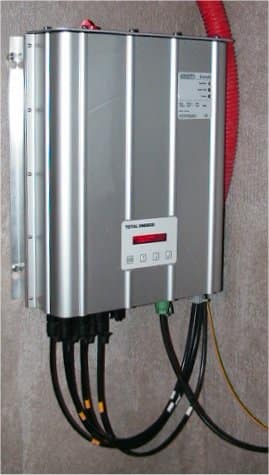
Every solar system has one component that decides whether the rest of it works, and almost nobody can describe what it is. A buyer will spend an hour comparing panel brands and then accept whatever the solar inverter the installer included happens to be. That is backwards. The panels are the part that does not fail. The solar inverter is the part that does, it is the part that limits what your system can ever do, and it is the part nobody warns you about at the point of sale.
The one job a solar inverter does
A photovoltaic panel produces direct current. Direct current flows one way only, and its voltage rises and falls continuously with the light. Almost nothing in your house runs on it. Your distribution board, your television, your phone charger, your washing machine motor, every one of them expects alternating current at a stable voltage and a stable frequency, the same thing the grid delivers.
The unit performs that conversion and does four further jobs while it is doing it. It regulates the output so the voltage and frequency stay inside the narrow band your appliances tolerate. It synchronises with the grid, in a grid-tied system, so that its waveform matches the grid’s phase and frequency to a tolerance much tighter than any lamp could detect but much looser than a piece of laboratory equipment. It provides overload and thermal protection for itself. And, in the types that matter most in Nigeria, it manages the battery: charging it, discharging it into the house, and switching between the two without the appliances noticing.
That switching is the part worth understanding, because it is where Nigerian systems are usually designed badly. An inverter connected to a battery can do several things with the power: charge the battery when there is surplus, run the house from the battery, pass solar power straight through to the house, or take power from the grid. The way it prioritises those four behaviours is a configuration decision, and it is the decision that determines whether your system feels seamless or whether the lights flicker.
The types of inverter
There are three broad families, and the naming is inconsistent enough across brands that you should judge by function rather than by label.
Off-grid inverter
This is the original type and the right answer for a system with no grid connection, or for one where the grid is treated as absent. It runs entirely from the batteries. It needs a battery, because there has to be somewhere for the energy to be at night, and the battery bank is usually the largest cost in the system. Its strength is total independence. Its weakness is that every watt your house draws at 9pm comes out of the bank, so bank size and autonomy are directly coupled to your lifestyle.
Hybrid inverter
This has become the default choice for most Nigerian installations, and for good reason. A hybrid inverter has a battery connection, a grid connection and an array connection, and it manages all three. In daylight, solar power serves the house directly, and only the surplus charges the bank, which is far more efficient than pushing everything through the battery. When the grid fails, the same box switches to supplying the house from the bank. Because the same hardware does both jobs, a hybrid avoids the expense of a separate changeover and a separate backup inverter. We compare the architectures properly in off-grid versus hybrid versus grid-tied.
Grid-tied units have no battery at all. They synchronise with the grid, and when the grid fails they shut down, which surprises people. Their place in Nigeria is limited while outages are frequent, though one can make sense in a compound with a reliable connection, or where export arrangements apply. The control behaviour is set out in the same comparison, and net metering is worth understanding before you rely on it.
The specifications that actually matter
Ignore the marketing. Four numbers decide whether the inverter is right for your house, and a datasheet will tell you all four. Read them the way we explain in how to read a panel datasheet, and check them against your own load list.
| Specification | What it means | How to use it |
|---|---|---|
| Continuous output, in watts | The power the unit will deliver indefinitely without overheating or tripping | This is your sizing number. Add your running load and stay under it. |
| Surge or peak rating, in watts | The power available briefly to start a motor or compressor | Must exceed the inrush of your fridge, pump, air conditioner or grinder |
| Apparent power, in volt-amperes | Volts multiplied by amps, which includes reactive load | Capacitive and motor loads draw VA well above their watts |
| Battery voltage range, in volts | Which bank it will work with, such as 24 or 48 volts | Fixes the battery configuration before you buy anything |
| Efficiency at low load | Conversion efficiency when the house is drawing very little | Matters at night on standby power, when losses are proportionally huge |
| Transfer time, in milliseconds | Gap before the house is resupplied after a grid failure | Below roughly 20 ms the lights stay on; above it, they blink off and on |
The distinction that causes the most damage is continuous versus surge. A compressor does not start at its running wattage. It starts at a multiple of it, and it does so while everything else in the house is also drawing power. An inverter chosen on nameplate watts without any surge headroom will trip every time the compressor kicks in, and repeated tripping is not a nuisance, it is a wear mechanism. Size for the surge, then confirm the continuous rating still covers your running load with room to spare.
Why the inverter is worth spending more on
Panels are a commodity. Any two 450 watt panels from any reputable manufacturer will produce essentially the same energy, and the difference between a cheap one and an expensive one is measured in tens of watts, not hundreds. An inverter is not a commodity, and the reason is that everything about your experience of the system passes through it.
A better inverter has better conversion efficiency, so a larger share of what the panels capture reaches your sockets rather than becoming heat. It has better low-load efficiency, which is what determines how much a bank is drained by standby loads overnight. It has a battery management system that respects the battery’s chemistry and temperature, which is the difference between a bank that lasts and a bank that is destroyed. It has a fault log you can actually read. And it has a transfer time short enough that the lights do not blink. Those are the things you are buying, and they are not visible in a price comparison of watts.
There is a second reason, and it is the one that matters when the grid is unstable. A cheap hybrid inverter is often one with a short transfer time, a coarse battery charge setting and no monitoring. During a season of frequent outages, the battery does far more cycles than its warranty assumes, and the cheapest box on the market is the one that charges it hardest. The inverter type comparison goes deeper on how the charge profile should be set.
Frequently asked questions
What does an inverter actually do?
It turns the direct current the panels produce into the alternating current your appliances need, keeps that output stable in voltage and frequency, and, in a hybrid or off-grid unit, manages the battery so it charges when there is surplus and discharges when the panels cannot keep up. It is the component that turns sunlight into usable household electricity.
How long does one last?
It depends far more on heat and how hard it is run than on the label. A unit mounted in an unventilated enclosure in a hot northern compound, driving a bank that is deeply discharged daily, will fail well before a comparable unit in a cool ventilated enclosure. Expect five to fifteen years, with the shorter end common in poorly ventilated installations. A replaceable-fan design rather than a sealed fanless one is a sensible hedge in a hot climate.
Can I run an air conditioner off solar?
Sometimes, and the condition is not about the air conditioner, it is about surge. A small unit may start within the surge capability of a mid-size inverter, but a larger split unit drawing around 1,500 watts will start at several times that, and running it for hours will flatten the bank by itself. Our article on running air conditioning on solar has the full arithmetic; the short version is that one air conditioner is a design decision, not an afterthought.
Do I need an inverter with a battery to have backup power?
Yes. A grid-tied inverter without a battery shuts down when the grid fails, by design, for safety. Backup power requires a battery connection. What determines how long the backup lasts is the bank size relative to your evening load, which is the subject of sizing a solar inverter and battery bank.
Key Takeaways
- A solar inverter converts direct current to alternating current and manages the battery. That is the whole job, and everything depends on it doing it well.
- Hybrid is the right default for most Nigerian homes because one box handles array, battery and grid.
- Size on continuous output for your running load, and leave genuine headroom for motor surge.
- Check transfer time before you buy, because a long gap means the lights blink off during every outage.
- Panels are a commodity and the inverter is not, which is why it is the place to spend.
- A grid-tied inverter with no battery gives you no power at all when the grid fails.
Once you have chosen a type, the next step is working out the numbers, and our guide to sizing a solar inverter and battery bank is where that starts.
Sources: solar inverter, types, topologies and specifications; photovoltaic system, components and conversion losses; alternating current and why it is the useful form of electrical power.


0 Comments