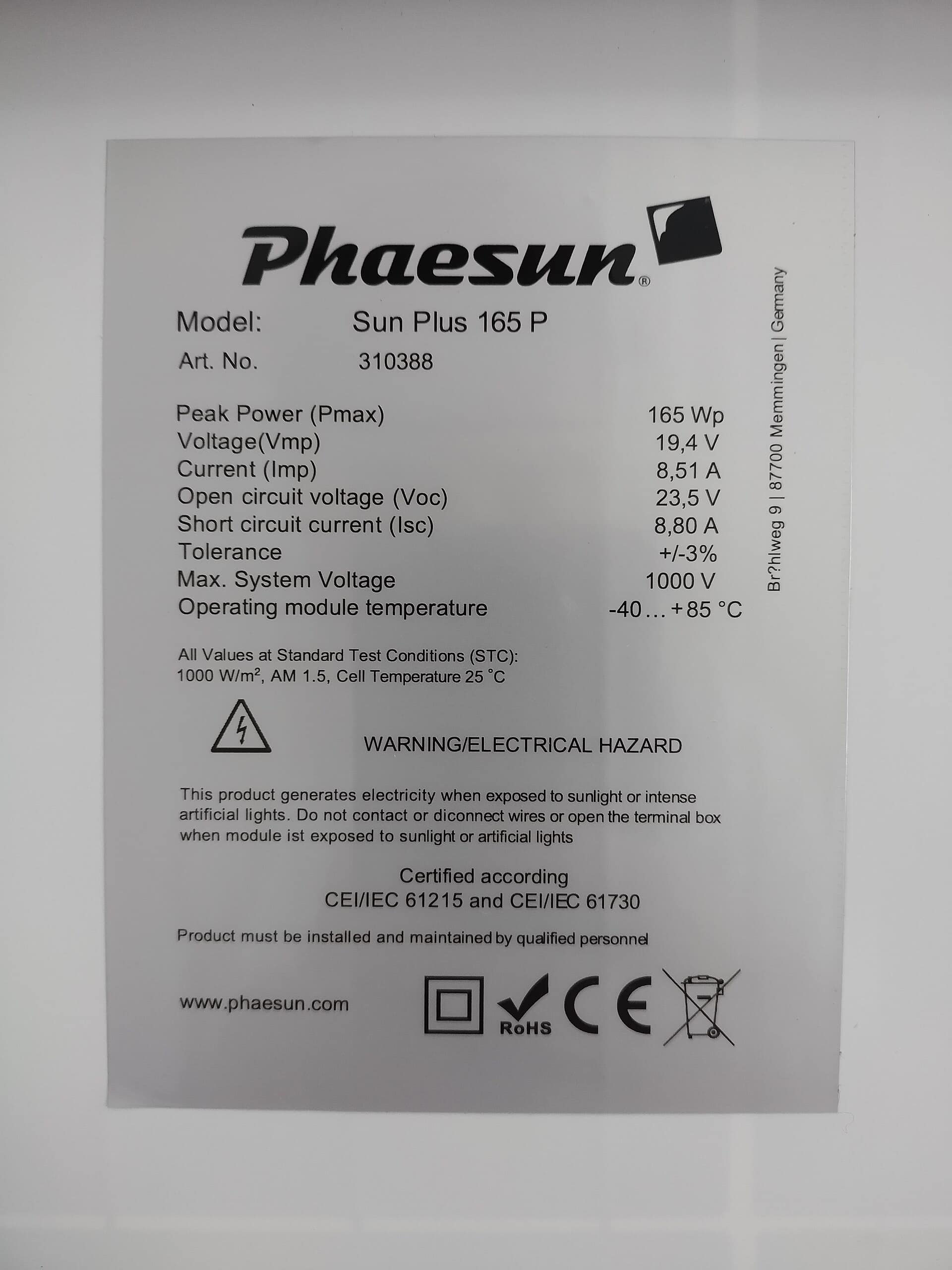
The moment a serious solar quote arrives in Nigeria, it arrives with a datasheet. Most people treat it as a compliance document, something to glance at and file. It is actually the only place the truth about a panel lives: the watts it makes, the voltage it will push into your charge controller on a cold morning, how much it gives back when the cell hits seventy degrees, and whether any of it was measured or simply printed.
Ten minutes with the solar panel datasheet tells you whether a system is properly specified, whether the string voltage is safe, and whether the invoice matches a real product. Here is each line, in the order you should read them.
What a solar panel datasheet is, and what it is not
A module datasheet has two halves. The first half describes the physical object: dimensions, weight, frame, glass, junction box, back sheet, connector type, number of cells, and the certifications. The second half is the electrical section, and that is where a good installer and a good buyer spend their time.
Everything electrical on that sheet is measured under one specific set of laboratory conditions: irradiance of one thousand watts per square metre, a cell temperature of twenty-five degrees Celsius, and a defined air mass spectrum. That is not a Nigerian afternoon. It is a controlled bench test in a laboratory, and every real number you will ever see from a panel is a departure from it. The datasheet is therefore a reference point for comparison, not a prediction of your bill.
One more thing to say plainly, because it causes arguments: nominal power is not the power the panel will produce on a hot day. The literature is blunt about this. Actual conditions typically deliver fifteen to twenty per cent less generation than the nameplate figure, largely because the cell is working far above twenty-five degrees. If a supplier promises you the nameplate number on a real day, that is not optimism, that is somebody who has not read the datasheet.
The four numbers that matter most
Maximum power point voltage, maximum power point current, open-circuit voltage and short-circuit current. Everything else in the electrical block is a refinement of those four.
| Term | What it means | Why you care |
|---|---|---|
| Pmax | Maximum power in watts, measured at one test point | The number that sets your inverter and array size |
| Vmp | Voltage at the maximum power point | The voltage your charge controller actually works at |
| Imp | Current at the maximum power point | The current your cables and controller must carry |
| Voc | Voltage with no current drawn, at open circuit | The worst-case voltage your controller must survive |
| Isc | Current with the terminals shorted | The worst-case current your fuses and cable must carry |
| Fill factor | How rectangular the power curve is, Pmax divided by Voc times Isc | A quality indicator. A high fill factor means a healthy cell |
| Efficiency | Pmax divided by the panel’s area | How much you get per square metre of roof |
| Max system voltage | Highest permitted series voltage | A safety limit from the module certification |
Notice that Pmax is not Voc multiplied by Isc. Multiply those two and you get the theoretical rectangle under the power curve; the fill factor measures how much of it the panel actually fills. A healthy modern crystalline module runs a high fill factor, and a falling one is a symptom of degradation or damage. This is why a panel with a suspiciously tidy set of numbers deserves suspicion rather than admiration.
If you want the wider picture on how the ratings relate to the rest of the system, poly vs mono solar panels explains the efficiency gap between module types, and bifacial solar panels cover the two-sided variants whose ratings are measured differently.
The voltage window your charge controller must survive
This is the calculation that separates a working system from an expensive paperweight. Panels in series add their open-circuit voltages. That total must sit below the maximum input voltage of the charge controller, and it must be checked on the coldest morning you can expect, because a panel produces its highest open-circuit voltage when it is cold and bright, which in Nigeria means a clear December or January dawn before the sun is fully up.
Take a 450 watt panel with a Voc of around fifty volts. Ten in series gives five hundred volts at the absolute worst case. If your controller is rated to a maximum of four hundred and fifty volts, the system is not safe, and it will not be obviously unsafe until a cold morning when it trips or, worse, when something inside the unit fails. Series and parallel planning is a datasheet job. pwm versus mppt charge controllers covers why the controller’s input window matters so much, and 24v versus 48v solar systems covers the bank voltage side of the same decision.
Two more datasheet lines earn their keep: the maximum series voltage and the maximum parallel current are safety limits written by the module manufacturer, and a string that breaks them can void the certification. The recommended number of modules in series and parallel tells you the range the design should stay inside.
Temperature coefficients and NOCT
Cold raises panel voltage and lowers current slightly. Heat does the opposite, and far more strongly. The datasheet states this as coefficients: beta for the variation of open-circuit voltage with temperature, alpha for short-circuit current, and delta for maximum power. The one to look at is delta, quoted as a percentage of output per degree Celsius.
Do the arithmetic and the hot-weather penalty stops being abstract. At a coefficient of about minus 0.35 per cent per degree, a cell running forty-five degrees above the test temperature loses close to sixteen per cent of its rated power. Multiply that by an array of panels in series on a still, hot afternoon and the string voltage is also sitting well below its nameplate, which is exactly when a poorly chosen controller stops harvesting.
NOCT, the nominal operating cell temperature, is the number that estimates this without a thermometer. It is the temperature a module reaches in a specific standard test with no wind and a defined irradiance, and it is usually somewhere in the mid-forties in Celsius. A panel installed on a dark roof in a hot interior can easily run above its NOCT, while a panel with air moving behind it runs below it. That is why panel cleaning in Nigeria and the mounting detail underneath the array both change real output, not just its appearance.
How to spot a panel rated on paper only
Some red flags are visible without any equipment. A datasheet with no manufacturer address and no model number is not a datasheet. A claimed efficiency far above anything else on sale is a warning. A datasheet that lists no temperature coefficients, no fill factor, no NOCT and no certification standards has been written by someone who does not have the measurements.
Then check the physical marks. The model number on the label must match the certificate, the certificate must cite IEC 61215 for performance and IEC 61730 for safety, and the barcode and serial must be readable. A panel with a smooth, featureless label and a suspiciously cheap price is the classic counterfeit profile, and a real factory publishes a real document.
Finally, insist on measuring. A decent commissioning test compares array output at a known irradiance against the expected figure, and any shortfall gets explained at handover instead of discovered two rainy seasons later. The documents to ask a Nigerian installer for before work starts should include the module datasheet for every panel in the design.
Frequently asked questions
Where can I find the datasheet for my panels?
On the label inside the frame, on the supplier paperwork, and usually on the manufacturer’s website under the exact model number. Take the model from the frame rather than the invoice, because suppliers do substitute models. If the installer cannot produce the datasheet for what is actually on your roof, that tells you something important about how the rest of the work was done.
Is a higher Pmax always a better panel?
No. Pmax is measured at one laboratory point, and a panel with a higher Pmax can still be a poor choice if its temperature coefficient is weak, its warranty is thin, or its real output is a fraction of the claim. Use Pmax to size the system, not to judge quality. Quality shows up in the fill factor, the temperature coefficients, the warranty terms and the certification.
What does the Voc and Isc rating mean for a 48V system?
Voc is the highest voltage the panel will push when nothing is connected, and Isc is the current it will deliver with the terminals shorted. For a 48 volt bank you must confirm that the series string voltage, including cold-morning Voc, stays inside the controller’s window, and that the parallel Isc total stays inside its current rating. Both numbers are on the datasheet for exactly this purpose.
Do I need the datasheet if my installer is experienced?
You need it anyway. Experience reduces mistakes; it does not remove the need for the number that decides whether your string voltage is safe. A good installer is already working from the datasheet and will be glad you are reading the same document.
Key Takeaways
- Every electrical rating on a module datasheet is measured at twenty-five degrees and one thousand watts per square metre, not in your compound.
- Pmax, Voc, Isc and the fill factor are the four numbers that matter; the rest is refinement.
- Add the cold-morning Voc of every panel in series and keep the total inside the charge controller window.
- The maximum power temperature coefficient is the number that explains your July output.
- A solar panel datasheet with no model, no coefficients and no IEC reference is a printed guess, not a measurement.
- Ask for the datasheet of the model actually installed, not the model on the quote.
Once the ratings make sense, the next step is deciding how many modules you actually need, which is covered in how many solar panels you need in Nigeria.
Sources: nominal power and standard test conditions, and the fifteen to twenty per cent reduction between nameplate and real conditions; solar panel electrical characteristics, the temperature coefficients for voltage, current and power, and the IEC 61215 and 61730 standards; fill factor, defined as maximum power divided by open-circuit voltage times short-circuit current; open-circuit voltage, the voltage a cell develops with no load connected; how a solar cell converts light into electrical current.


0 Comments