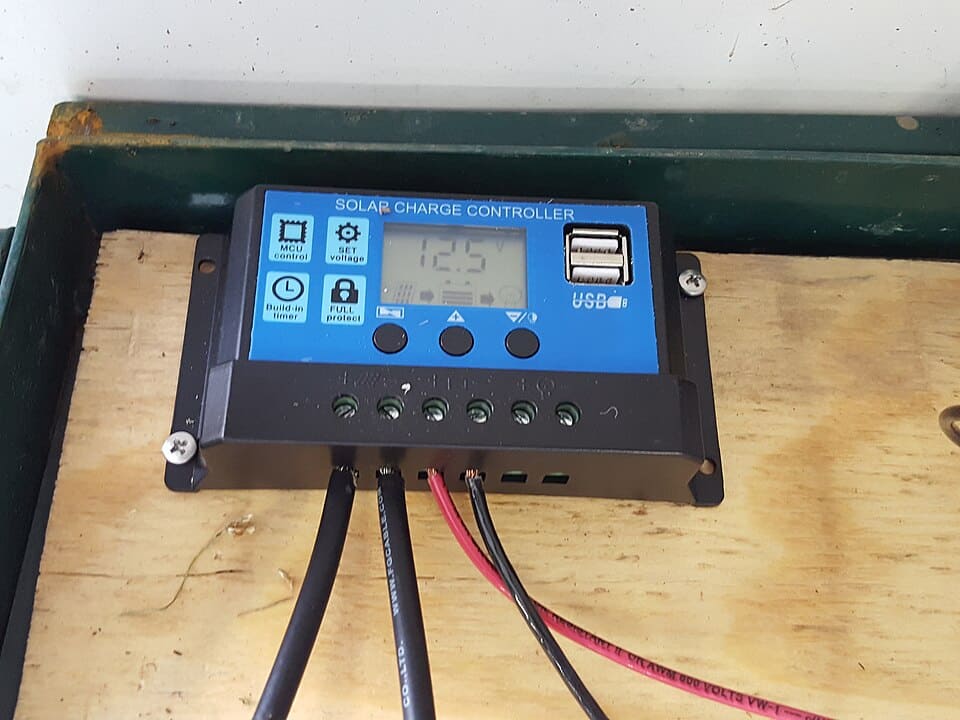
The cheapest way to make a Nigerian solar installation lose a meaningful slice of its output is to fit the wrong charge controller, and the loss is invisible because the panels still show a full charge in the middle of the day. A shunt regulator wastes whatever the array produces above the bank voltage, as heat. An mppt charge controller does the same job without the waste, and the difference between them is usually the largest single efficiency decision in the system. It is also the one most often settled by whichever unit the installer happened to stock.
What a charge controller actually does
The job is unglamorous and it is the protection of the bank. It limits the current going in and coming out, guards against overcharging and overvoltage, and, depending on the design, prevents the deep discharge that ruins a cell. Some also watch bank temperature, which matters more in a hot country than most manuals admit.
Two older designs are still sold and are worth recognising. A series unit simply stops current flow when the bank reaches a set voltage and starts again when the voltage falls back. A shunt unit diverts the excess into another load, often a water heating element, rather than destroying it. Both are honest engineering, and both are limited in a different way. The question is which is matched to your array voltage, your bank voltage and the gap between them.
| Feature | PWM design | MPPT design |
|---|---|---|
| How the array is connected | Array voltage held at the bank voltage by rapid switching | A direct current converter presents a variable load to the array |
| Where the array operates | At the bank voltage, not at the panel’s own best point | At the maximum power point, wherever that moves to |
| What happens to excess energy | Becomes heat in the switching element | Becomes additional current into the bank |
| Array voltage freedom | Array must sit close to bank voltage | Wide input window, so a high-voltage string can feed a lower-voltage bank |
| Behaviour in heat | Bank voltage rises with temperature, so the gap widens | Tracking compensates for most of the change |
| Reasonable for | Small arrays on a low-voltage bank, where the gap is small | Modern high-voltage panels on any bank |
Where the watts actually go in a PWM system
A photovoltaic panel is not a fixed voltage source. Its voltage at maximum output sits below its open-circuit voltage, and the ratio between the two changes with temperature, sitting at roughly 0.76 for a typical crystalline silicon module. This is why an installer who adds panels in series must check the cold-morning open-circuit voltage against the unit’s input limit.
A PWM design takes the simplest approach to the mismatch. It connects the array to the bank through a switching device turned on and off very quickly, and the average of that switching sets the voltage the array sees. The array therefore operates at the bank voltage rather than at its own best point, and every watt of difference between those two figures becomes heat.
Here is the arithmetic that decides everything. On a hot afternoon a bank absorbing charge sits near its absorption voltage, higher than its resting voltage and higher again inside a warm enclosure. An array whose best output voltage is well below that is held away from its own optimum by exactly the difference. On a cold morning the bank voltage is lower and the loss is smaller. The unit has not changed. The gap has, and that gap is heat.
When an mppt charge controller earns its money
The mechanism is the opposite one. An mppt charge controller inserts a direct current converter between array and bank and varies its duty ratio, which changes the effective load presented to the array, which moves the operating point along the panel’s power curve until it sits at the maximum. Most use a perturb-and-observe method, nudging the voltage and watching whether power rose or fell, or an incremental conductance method that predicts the change directly. The practical difference from outside is simple: the array runs at the best point available instead of at the bank’s voltage.
Two things follow. First, the energy a shunt design turns into heat is collected as current instead. Second, and often more valuable, the array is no longer tied to the bank voltage. A string can be wired high and still charge a lower-voltage bank, which is why a unit with a wide input window can accept modern high-voltage panels on a 48 volt system. How to read a solar panel datasheet covers the numbers this depends on.
There is a secondary benefit that matters in some installations. A unit working the array hard generates more heat itself, so a cheap one in a hot, unventilated enclosure is not just less efficient, it is closer to its thermal limit. Buying the better unit and putting it in a shaded, ventilated box is the combination that survives an April afternoon, and where a solar budget should go treats that enclosure as part of the cost rather than an afterthought.
Shade, dust and module mismatch
Neither design can rescue a badly matched array, but they behave differently when the array is not uniform. A unit that applies one operating point to a whole string forces every panel in it to carry the same current. Panels differ from the factory, they age at different rates, and one that is shaded, soiled or covered in bird droppings pulls the current down for all of them, so the loss is a multiple of what that panel alone would suffer.
Tracking per string does not remove the effect, because the string still has to agree. What fixes it is per-panel tracking, with a microinverter behind each panel or an optimiser on each panel feeding a string unit. Panel design helps too: half-cell modules, frameless formats and panels with more bypass diode sections all reduce the penalty. Half-cut solar cells covers that, and solar panel cleaning in Nigeria covers keeping the array uniform in the first place.
When a PWM controller is genuinely good enough
Three cases where the money is better spent elsewhere
A PWM design is defensible in several common situations, and choosing one frees budget for a better bank or a larger array. The first is a small array of a few hundred watts on a low-voltage bank, where the difference between array and bank voltage is a couple of volts and the wasted fraction is tiny. The second is a short cable run, because the cable losses a tracking design can offset are small at that distance. The third is a seasonal load such as a garden pump or lighting, where the absolute energy difference is small.
What is not acceptable is being told a PWM unit is equivalent to a tracking one at a lower price. It is not, and on a modern array feeding a 48 volt bank the difference in collected energy pays for the upgrade.
Sizing the unit and checking the voltage window
Size it in current, not in watts, and give it headroom for a bright cool morning, when your panels pass the most current they ever will. A unit exactly right on a mild day will be limiting when the light is bright and the air is cold, and a unit that clips its output wastes the moment the system exists for.
Check the input window properly. A low maximum input voltage forces shorter strings, and a high minimum voltage will refuse to start in the morning haze, which is exactly when you want it to. A shunt design is worth considering where a large electrical load already exists, because it sends surplus somewhere useful. Battery bank sizing is where the two decisions meet, because the unit and the bank have to agree about voltage.
Frequently asked questions
Is an MPPT controller always worth the extra cost?
On a modern array it usually is, and the reason is the array-to-bank voltage gap. With high-wattage panels on a bank that charges at a higher voltage, a shunt design can give away a substantial share of what the panels produced. On a tiny array feeding a low-voltage bank the gap is small and so is the benefit. Compare your panel power voltage with your bank charging voltage and the answer falls out.
Does the controller matter more than the panels?
No, and the priority order is usually backwards in Nigerian sales conversations. Panels produce the energy and no charge controller can create more of it, but it decides how much of what the panels produce is collected. Panels come first, and once they are settled this is the next decision that changes your yield.
Will one MPPT controller for the whole array be enough?
It will be if the array is uniform and unshaded, which in Nigeria means no shade in the morning or late afternoon, no soiling hotspots, and panels bought as a matching batch. If any of those fail, one tracker per string takes the whole string down with the weakest part, and optimisers on the affected panels are a cheaper fix than microinverters on all of them.
Can I add a charge controller later?
Frequently, and it is worth checking that the system was designed for it, because the unit needs somewhere to sit in the circuit and the wiring has to suit. If the original was a shunt design fitted in series, adding a tracking unit usually means changing the wiring as well as the box. Ask whoever installed it for the schematic first.
Key Takeaways
- A PWM unit holds the array at the bank voltage, and the difference becomes heat.
- An mppt charge controller moves the array to its own best point, so more of what the panels produce is collected.
- The bigger the gap between panel voltage and bank charging voltage, the more the choice matters.
- A high-voltage array on a 48 volt bank is exactly the case where a shunt design wastes the most.
- A PWM design is defensible on a small array with a short cable run, so spend the money on panels or bank instead.
- Size on array current with headroom, and check the input window against a cold-morning reading.
The unit and the bank have to agree about voltage, and battery bank sizing works through the second of those decisions.
Sources:
charge controllers, series and shunt designs, and the advantage of matching power point tracking to battery voltage; maximum power point tracking, the perturb-and-observe and incremental conductance methods, and battery operation at night; buck converter, the switching stage that holds an array at the bank voltage; boost converter, the stage that lifts a bank voltage toward the array voltage; how a solar cell converts light into electricity.


0 Comments