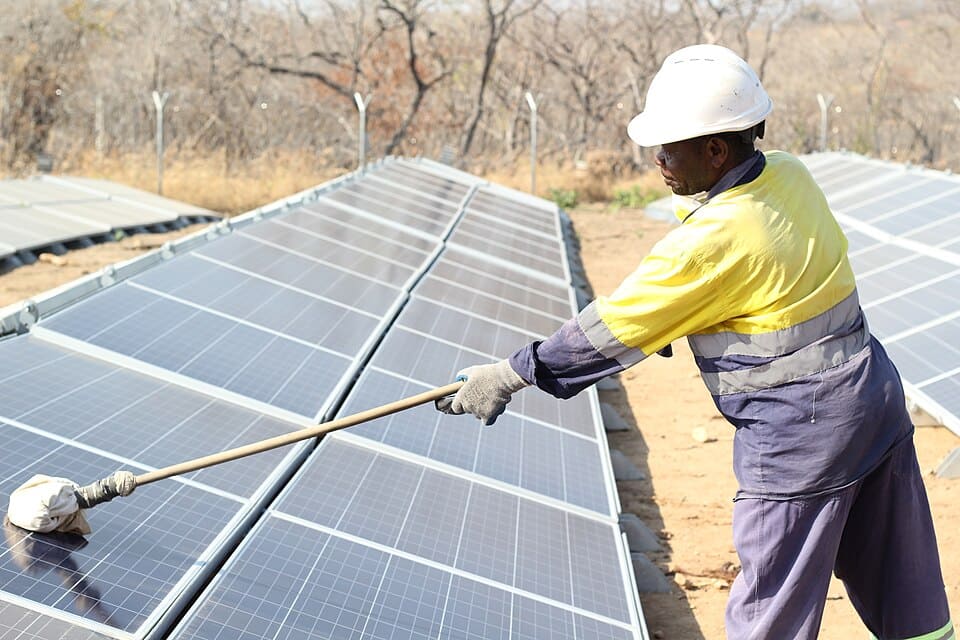
A 2 kW array on a Lagos roof in March can lose a sixth of its output to what is sitting on the glass, and the owner will blame the panels. Soiling is invisible in a photograph, hard to see from the ground, and quietly subtracted from every month’s production until someone climbs up with a bucket. Solar panel cleaning is the cheapest efficiency gain available in a hot, dusty country, and the cheapest way to destroy a panel at the same time. The difference is entirely in the method.
What soiling does, and why it matters here
Soiling is the accumulation of material on the light-collecting surface of a module. It matters because the cell depends on light arriving through that surface, and the accumulated layer blocks some of it outright while scattering the rest. The deposited material in Nigeria is predictable: mineral dust from bare ground and unpaved roads, construction dust, agricultural matter, and soot and grit from traffic and generators. Add pollen, fungal growth in the humid months and bird droppings, and you have a layer that is partly opaque, partly diffusing and locally corrosive.
The scale deserves attention without exaggeration. Globally, average annual power loss attributed to soiling has been put at around 5 to 10 per cent, while regions with frequent rain can sit below 1 per cent because the rain does the work. Nigeria sits between those two. The harm is concentrated in the dry months and accumulates fastest near a dusty road, a construction site or a generator exhaust outlet rather than on a clean estate.
| What is on the glass | How it hurts | How it comes off |
|---|---|---|
| Mineral dust and road grit | Blocks light in an even film, so the loss is proportional and invisible | Water and a soft cloth or brush, in the cool part of the day |
| Soot and generator exhaust | Dark film plus sticky binding that holds other dust to the surface | Water first to loosen, then a mild detergent if the film persists |
| Construction dust | Sharp particles that scratch tempered glass when dry | Never rub dry. Wet it first, always, even if it looks clean |
| Bird droppings | Blocks light and etches the glass chemically | Not by rubbing. Remove and treat the surface damage separately |
| Algae, lichen and biofilm | Holds moisture against the glass and shades cells in patches | Needs removal plus the reason it grew back |
| Pollen, leaves and sap | Seasonal, and sticky enough to trap dust after it falls | Water and a brush, before the film sets |
Two design facts separate a system that stays clean from one that does not. A steeper mounting angle sheds more accumulation and gives rain a better chance of washing the surface, and frameless modules avoid the ledges at the frame edge where grit collects. Half-cell modules help too, because a shadowed patch affects less of the module. Half-cut cells covers that.
How to clean a module properly
The only method that will not cause damage
Plain water, a soft cloth or brush, and time. That is the method, and everything else is a variation with a risk attached. Water on its own removes loose dust, which is most of the problem and most of the cleaning effort. A non-abrasive detergent helps with an oily film, used sparingly and rinsed fully, because residue on glass attracts the next layer of dust faster than bare glass does.
Timing matters more than technique. Clean early or late, not at midday. Water on hot glass in strong sun causes thermal shock, and tempered glass tolerates that but not indefinitely or at a thin edge. Wet the glass before you touch it, and clean a panel that has already cooled. A soft brush on a wet surface is safer than a cloth, and a non-abrasive pad for stubborn film is a last resort rather than a habit.
What never to do
Dry wiping is the first prohibition, and the most common. Grit acts like sandpaper, and one dry pass can scratch tempered glass permanently. The scratch is not cosmetic: it changes how light scatters across the cell, and a hazed panel produces less and runs hotter. A pressure washer is the second. The force that lifts compacted dust also drives water into the frame seals and the junction box, and the failure appears months later as corrosion inside the enclosure.
Then there is the chemistry. Solvents and thinners attack the encapsulant and the backsheet, and alkaline cleaners attack the silver busbars at the cell edges. Bleach leaves a film that gets dirtier faster than glass. If a panel needs something stronger than mild detergent, it needs a professional with the right chemistry. Solar fire safety covers the other serious risk on a roof, which is electrical.
How often solar panel cleaning is really needed
There is no schedule that suits all of Nigeria, and anyone selling a fixed monthly plan without looking at your site is guessing. The variables that matter are the dust concentration where you are, the direction the prevailing wind blows from, whether the array sits near a road or a construction site, the mounting angle, and how much of the surface gets morning and late shade. A roof beside a busy laterite road in the dry season needs attention far more often than an array on a balcony in a leafy estate.
The practical approach is measurement rather than a calendar. Compare output on a clear day against a clear day a fortnight earlier, at the same time of day, with the bank in the same state of charge. If production has drifted down by more than a few per cent with no cloud in the story, soiling is the first thing to rule out, and cleaning is then a free fix. Solar panel cleaning is cheap in naira and expensive in lost yield, which is the wrong way round. The solar system maintenance checklist covers the rest of the schedule, and array layout and tracking covers the other common cause of a shortfall.
Bird droppings and the damage that does not wash off
Droppings deserve their own section because they are the one soiling type that damages the panel rather than the output. The deposit is only partly the problem. What matters is what is in it, and the effect is a chemical attack on the glass that continues after the droppings are removed, leaving a matte, pitted patch that never returns to full clarity. One untouched dropping can be a permanent loss, while the surrounding dust is only temporary.
Handle it accordingly. Wet the deposit thoroughly, soften it, and lift it rather than scrape across the glass, then expect a surface mark afterwards. If birds are nesting in the array, cleaning without removing the nest resets the clock. Perching rails and deterrents placed above the mounting rail work better than anything sprayed on the glass, and physical protection is covered in preventing theft and damage to solar panels.
Access, safety and whether to do it yourself
The electrical risks are unglamorous and real. A module under full sun sits at a voltage well above mains and stays live whenever it is illuminated, so treat the array as energised even when the inverter is off and the bank is empty. Wet panels, wet roof sheets and a steel ladder are a poor combination, and a slipped ladder onto sheet roofing is the injury we see most often, not electrocution.
For a single-storey reachable array, cleaning it yourself is reasonable with a firm ladder and someone holding the base. For anything above one storey, on a steeply pitched roof, or on a frame above head height, the cost of a cleaning service is small next to the cost of a fall. Fixed walkways are a better long-term answer than repeated ladder work, and choosing a solar installer in Nigeria is worth reading before you commission anything that needs climbing.
Frequently asked questions
How often should I clean my solar panels in Nigeria?
Often enough that a clear-sky day does not show a steady downward drift in output, and in dry dusty locations that can be every few weeks rather than every few months. Near a busy road or a building site it will be sooner. Judge it by measured output rather than by the calendar, and remember that a light dusting on a steeply tilted array in the middle of a rainy stretch may need no attention at all.
Does rainwater work for cleaning?
Yes, and collected rainwater is often the only practical supply on a roof. Collect it in a closed tank, because an uncovered container grows the algae and biofilm you are trying to remove, and filter it, because grit defeats a soft cloth as effectively on the cloth as on the glass. Treated mains water is fine provided it is not softened water with a high detergent load in it.
Can I clean panels in the rainy season?
You can, and the rain does most of the work anyway. The reasons to intervene are the shaded and sheltered areas that never get rained on, the droppings that rain will not remove, and any biofilm that has taken hold. Just wait for a break in the rain before you climb, because a wet roof surface is where falls happen.
Is it worth installing panels that need less cleaning?
Frameless modules and steeper mounting reduce accumulation and give rain something to work with, so they help. The effect is real but modest compared with getting a competent clean, and neither substitutes for the other. If a supplier quotes frameless modules as a reason to never clean, ask what happens after the first dry season.
Key Takeaways
- Soiling blocks and scatters light, and the loss is proportional, so a dirty array underperforms quietly.
- Plain water, a soft brush and cool glass is the method. Everything stronger carries a risk.
- Never dry-wipe, never pressure-wash, and never use solvents or bleach on a module.
- Solar panel cleaning frequency should be set by measured output drift and by where the array sits, not by a fixed monthly plan.
- Bird droppings etch the glass, so the deposit must be softened and lifted, not scrubbed.
- Above one storey, the cost of a cleaning service is trivial next to the cost of a fall.
Cleaning is one line on a longer list, and the solar system maintenance checklist sets out the rest of what a system needs each year.
Sources:
soiling in solar energy, typical deposited material, measured loss ranges and mitigation options; solar panel construction, glass and the effect of soiling on output; PVGIS, the European Commission tool for modelling photovoltaic yield and soiling losses on a specific site; Global Solar Atlas, mapped solar resource and photovoltaic yield data by location.


0 Comments