A solar installation in Ile-Ife and a solar installation in Kano age in completely different ways. Kano gets dust, harmattan and 45 degree heat; Ile-Ife gets humidity, rainfall and mould on the underside of every panel. Most systems do not fail dramatically. They quietly lose output, the battery bank ages faster than the warranty claims, and the owner concludes the technology was oversold. In practice the cause is usually far more boring: nobody ever did the solar system maintenance that the equipment documentation assumes somebody would do.
What solar system maintenance actually involves
Maintenance on a solar system is not one task. It is four separate jobs on four different timescales, and they have different owners depending on whether you installed it yourself or hired a firm. The first is keeping the modules clean. The second is watching the battery bank, which is the only component that wears out on a known schedule. The third is checking the electrical connections, which fail in a predictable pattern. The fourth is reading the inverter, which is the one component that will usually tell you in advance that something is wrong.
None of these jobs is difficult. All of them are skipped, and skipping them is the single largest avoidable cause of a disappointing yield in this market.
The component that actually wears out
Panels last decades. Inverters last somewhere between five and fifteen years depending on heat and how hard they are driven. Batteries last far less, and their lifespan is set by three things: how deep they are discharged, how hot they run, and how many cycles they do. A bank that is routinely emptied to 20 per cent in a 35 degree room will be finished long before the panel warranty is up. Preventive maintenance is the only lever you have over two of those three variables. The reference figures for depth of discharge and cycle life are in our guide to battery bank sizing, and the chemistry trade-off is in lithium versus lead-acid.
Keeping panels clean in Nigerian dust
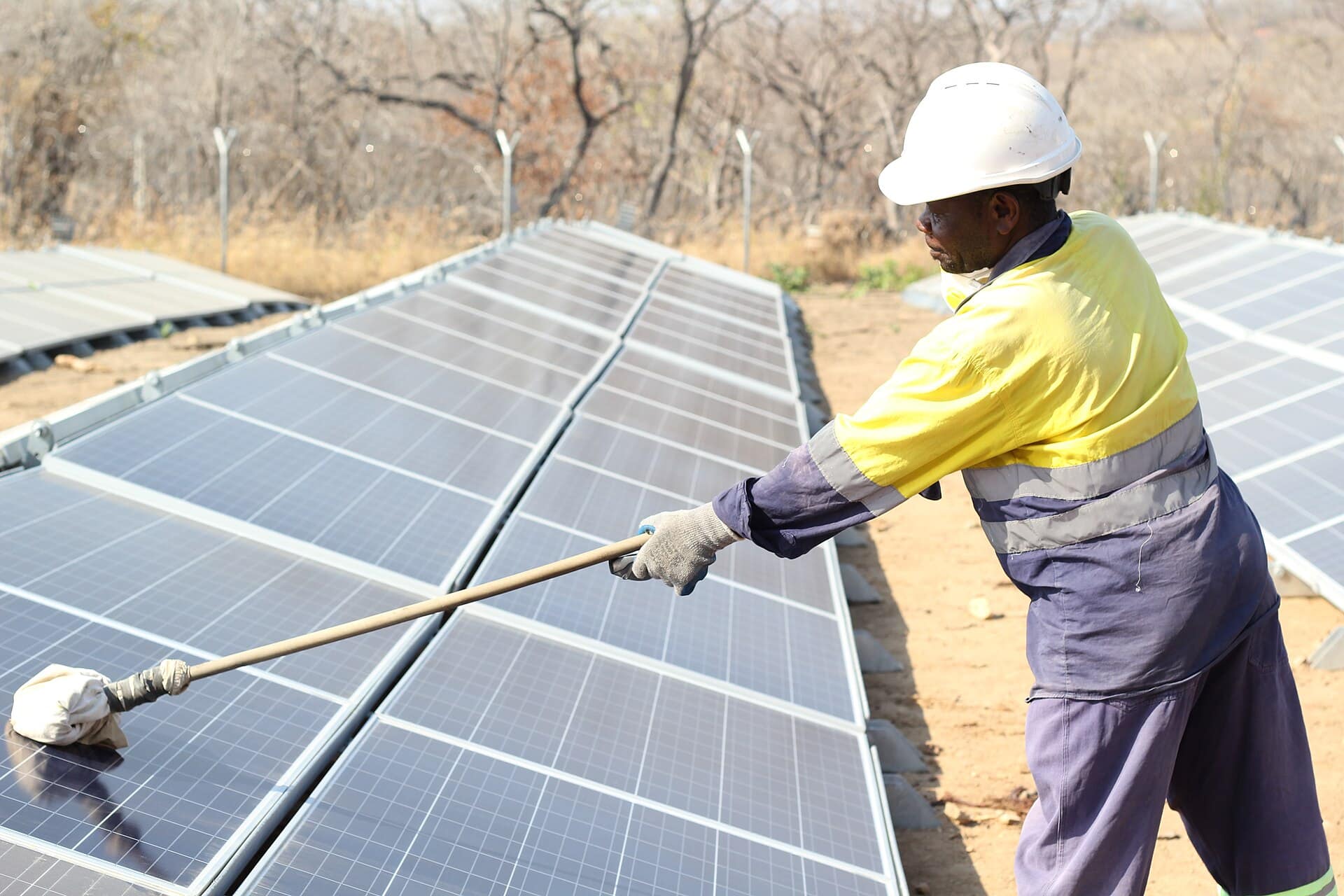
Dust is the most visible problem and the least important one to obsess over. A light dust film costs a few per cent of yield and takes minutes of maintenance to put right. A thick layer of caked dust, bird droppings and the film that follows heavy harmattan can cost a great deal more, and bird droppings are worse than they look because the acid etches the glass permanently if it is left. The physics of soiling losses and the safe cleaning method are covered in our article on solar panel cleaning in Nigeria.
The practical guidance is simple. Clean when the glass is visibly soiled rather than on a rigid calendar, because soiling rate depends on your site: a plot beside an unpaved road, a building under construction, or a compound with bare laterite will need attention far more often than a tiled roof in a leafy street. Clean early in the morning or late in the evening, never at midday, because cold water on a hot panel will crack the glass. Use clean water and a soft cloth or a non-abrasive brush. Never use a pressure washer, never use detergent, and never clean from a ladder you are holding with one hand while scrubbing with the other.
Batteries, terminals and connections
This is where maintenance pays back the most, and where neglect is most expensive. Lead-acid banks in particular produce hydrogen gas during charging, which is why ventilation matters, and they corrode their own terminals over time. A corroded terminal adds resistance, which means the charge controller is working harder and the cable runs hotter than they should.
Twice a year, as part of a proper maintenance session, disconnect the load, clean the battery terminals with a terminal cleaner or a solution of bicarbonate of soda and water, dry them thoroughly, and refit. Do not use a file on a lead post, because you remove lead and then you have lead dust on your hands. While you are there, check that the cable lugs are tight and that no insulation has chafed where a cable passes through a wall or a conduit. Check the electrolyte level on flooded lead-acid banks and top up with distilled water only.
Lithium banks need less of this, but they still need their terminals checked on the same maintenance schedule, and they need the temperature sensor left in place. A lithium battery managed without a temperature sensor is being run outside the conditions its warranty assumes, and the manufacturer will use that to refuse a claim.
Reading the inverter and its error log
Your inverter is the only part of the system with a display and a memory. Treat it as the diagnostic tool it is. Once a month, look at the daily energy figure and compare it against what you expect for the season. A gradual decline across a season is normal as soiling builds up and as temperatures change. A sudden drop on a clear day is not normal, and it is usually either a string producing far below its neighbours or a shading problem that has grown with a new building or a new tree.
When the inverter reports a fault, read the code rather than resetting it and walking away. Fault codes for over-temperature, under-voltage, over-current, grid synchronisation failure and battery under-voltage each point to a different subsystem, and our guide to what a solar inverter is and what its specifications mean explains which. Resetting a fault that is a symptom of a real problem is the most common way a small fault becomes an expensive one. If a fault recurs, the error log will hold a history that a technician can use, so do not clear it before it has been read.
If your system has remote monitoring, use it. It costs nothing and it converts a fault you would have discovered at bedtime into a fault you discover before leaving for work. Be aware, though, that monitoring portals have their own security requirements, which we cover in securing your solar monitoring portal.
A monthly, quarterly and annual schedule
Print this or keep it on your phone. The schedule is deliberately short, because a checklist nobody completes is worse than no checklist, and because most solar system maintenance needs are small and quick once you know which day to do them on.
| Interval | Task | Why it matters |
|---|---|---|
| Monthly | Read the inverter daily yield and fault log; clean panels if visibly soiled | Catches a developing fault before it becomes a failure |
| Monthly | Walk the array and look for shading, bird droppings, loose mounting or cable movement | Shading and corrosion both develop gradually |
| Quarterly | Check battery terminals for corrosion, confirm cable tightness, check electrolyte on flooded banks | Corroded terminals raise resistance and heat |
| Quarterly | Confirm earthing continuity and the operation of protective devices | Protection is invisible until it fails |
| Annually | Full electrical test by a competent person: insulation, earth fault, inverter settings | Settings drift after firmware updates |
| Annually | Recompute expected yield from a resource map and compare with actual output | Separates soiling losses from equipment faults |
| Every 3 to 5 years | Capacity test of the battery bank | Batteries degrade long before they fail outright |
Frequently asked questions
How often should solar panels be cleaned in Nigeria?
Based on how dirty they look rather than on a calendar. In dusty northern locations and on unpaved compounds, expect to need attention several times a year, and more often during harmattan. In a cleaner southern site, twice a year is usually enough. The test is simple: if you cannot read your reflection in the glass, clean it. Washing panels that are only lightly filmed wastes labour and water and can scratch the surface.
Do I need a technician, or can I do solar system maintenance myself?
For cleaning, visual inspection and reading the error log, no. Routine solar system maintenance of that kind needs no tools and no training. For anything involving opening the inverter, disconnecting the battery bank, testing earth continuity or changing settings, yes. Those tasks involve lethal voltages and stored energy that remains after the system is switched off, and the inverter may still hold charge from the array in bright conditions.
How do I know if my battery is failing?
Three signals, in order of appearance. First, the system stops reaching full charge on a clear day, so the state-of-charge reading never gets to full. Second, the backup runtime shrinks noticeably. Third, the bank takes longer to recover and the inverter begins reporting under-voltage or over-temperature events more often. A capacity test is the reliable answer, and our article on battery bank sizing explains how usable capacity shrinks as the bank ages.
Does solar still work during the rainy season?
Yes, but with lower output, and that is physics rather than a fault. The physics is explained in our article on solar panels in the rainy season. The maintenance implication is the one that catches people: panels that are not cleaned before the rains often come out the other side covered in dust, mould and splash marks, and they will not reach their expected yield until that is removed.
Key Takeaways
- Solar system maintenance is four jobs on four timescales: cleaning, batteries, connections and the inverter log.
- The battery bank, not the panels, is the component that ages on a predictable schedule.
- Clean when the glass is visibly soiled, never at midday, and never with a pressure washer.
- Read the inverter error code before resetting it, because the log is the only history of the fault.
- Keep the maintenance schedule in front of you rather than in a drawer, and treat the battery bank as the item with a deadline.
- Never open an inverter or disconnect a bank without a competent person present.
For the electrical side of keeping a system safe, read our guide to wiring safety during solar installation, and for fire prevention around the battery room see fire safety for solar systems.
Sources: solar panel cleaning and soiling losses; deep cycle battery, depth of discharge and cycle life; charge controller function and protection.


0 Comments