A 5 kWh bank is quoted. The inverter is 5 kW at 48 V. The family expects to run lights, a fridge, fans and a television until six in the morning. Three suppliers quote three different banks, from 3 kWh to 12 kWh, and all three are quoting the same label capacity. The difference between them is battery bank sizing, and it is the calculation that decides whether your house is comfortable at midnight or dark. Here is how to do it yourself, and how to check that somebody else has.
Battery bank sizing starts with the night, not the label
The bank only does one job: carry the building from after sunset until the array is producing again. So the sizing calculation begins with the energy used in that window, and with nothing else. If you cannot state that energy figure, battery bank sizing cannot proceed. Sizing the array is a separate exercise, and mixing the two is how quotes end up with too many panels and too little storage.
Take it from your solar load list. Split the daily energy into what the panels can serve directly and what has to come out of the bank, then add inverter losses. A common and defensible shortcut is to assume the sun covers about two thirds of the daily consumption, which leaves roughly a third for the night, and then check that against your own hours of darkness.
Amp-hours and watt-hours, and why the case misleads
Ah multiplied by volts gives watt hours, so a 200 Ah 12 V battery holds 2,400 Wh and a 100 Ah 48 V bank holds 4,800 Wh. The ampere hour measures charge rather than energy, and only becomes an energy figure once you know the voltage. This is why a bank quoted in ampere hours means nothing in a conversation unless both parties agree the system voltage: a 48 V bank and a 24 V bank quoted in the same units are two different capacities.
Then there is the difference between label capacity and usable capacity. The label assumes the cell is full, the discharge is slow, the temperature is right and the cell is new. None of those describe a battery in a warm compound in its fourth year. Solar battery storage covers that gap; the point here is that sizing must use usable energy, not label energy.
Two routes to the same number
There are two ways to reach a bank size, and they should agree. The first is the energy route, and it is the one to trust for sizing. Divide the night energy by the inverter efficiency, divide the result by the usable fraction of the bank, and you have the nominal capacity to buy. The second is the current route, which checks that the bank can physically deliver the current the inverter will ask of it.
The current route starts from the inverter. Output current is inverter power divided by bank voltage, so a 5 kW inverter on a 48 V bank can demand about 104 A. That figure sets the cable, the breaker and the interconnects, and the bank has to supply it without collapsing. Why 48 V is common above 3 kW comes down to this: the same power on a 24 V bank asks for twice the current and twice the copper.
Worked example, following on from the three-bedroom flat. Night energy at the sockets is 2.7 kWh. At 90 per cent inverter efficiency the bank must deliver 3.0 kWh. With lead–acid at a 50 per cent usable fraction that is 6.0 kWh of nominal capacity, and allowing a further ten per cent for heat and ageing, roughly 7 kWh. At 48 V that is about 145 Ah, so the practical build is two parallel strings of four 100 Ah cells, giving 200 Ah and 9.6 kWh. With lithium iron phosphate at an 80 per cent usable fraction the requirement falls to 3.75 kWh, which four 100 Ah cells in series cover at 4.8 kWh.
Depth of discharge is the number that decides your nights
Depth of discharge, or DoD, is the share of stored energy taken out per cycle, and it is the number that most often gets quietly assumed. For deep-cycle batteries a figure around half is the usual working target, because a deeper discharge buys capacity you will not get many times before the cells need replacing. Lithium tolerates more, typically eighty per cent or more, which is the single largest reason its sizing calculation comes out smaller.
Beyond the headline figure, two corrections apply. The first is that delivered energy is always below nominal during a discharge, because cell voltage falls under load and the usable window closes before the meter reaches zero. The second is the state of charge estimate, which is inferred rather than measured and drifts as cells age. A bank held at 20 per cent reserve rather than 5 per cent costs a fifth of the capacity and buys a much longer life.
Temperature, current and the derating nobody applies
Cold reduces available capacity, which is why battery sizing rules in colder climates carry a temperature correction factor. Nigeria runs the other way. Heat does not take capacity away in the same way, so the correction to apply here is to expected life rather than to capacity. A sealed bank in a hot, unventilated cabinet in July will still deliver its rated energy, and it will still be half the battery it was on the day it was installed. Plan the replacement budget on that basis.
Current is the other derating. Lead–acid capacity falls when it is discharged faster than the ten-hour rate, an effect known as the Peukert effect, so a bank sized for an evening of gentle use will disappoint if the same bank is asked to power a 2 kW kettle and a 370 W pump at once. There is no clever correction, only the sensible one: get the sizing right for the current you actually draw, and prefer a chemistry that tolerates high discharge. Our notes on lithium against lead–acid in Nigeria set out that trade-off, and solar fire safety covers why the enclosure and the cable matter as much as the cells.
Building a bank that is achievable here
Once the arithmetic gives you a number in kilowatt hours, the practical question is whether you can build it. Good battery bank sizing on paper is worth nothing if the bank cannot be delivered, carried in and ventilated where it is going. The three constraints people underestimate are weight, layout and heat.
Weight, plinth and floor loading
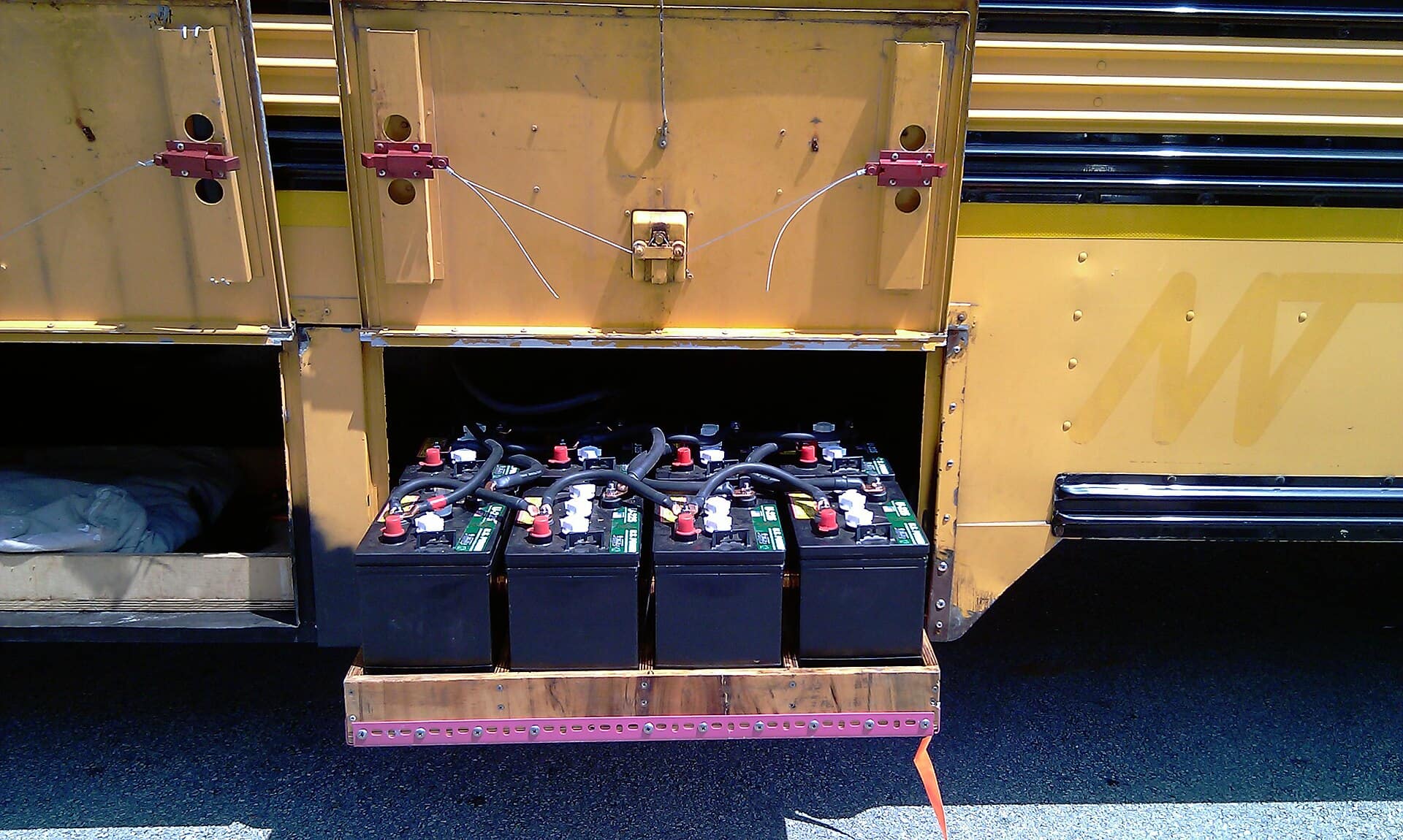
Lead–acid is heavy. A 5 kWh bank of flooded cells will weigh several hundred kilograms, and it needs a plinth, a level floor and a way of getting the cells into position. Ask for the total weight and the proposed location before the order is placed, and check the floor can take it. This single issue stops more installations than any electrical one.
On layout, build the bank in identical strings. Cells in series must be the same type, age and capacity, and parallel strings must match in length and state of charge. A bank made from whatever was available at the time behaves like the oldest cell in it. Ventilation matters too: sealed units still release gas when charged hard, so a battery room needs airflow and should not be a sealed cupboard inside a bedroom. The maintenance checklist covers the routine that keeps it healthy.
| Night load at the sockets | Lead–acid bank, 50 per cent usable | Lithium bank, 80 per cent usable |
|---|---|---|
| 300 W for 4 hours | 2.7 kWh | 1.7 kWh |
| 300 W for 8 hours | 5.3 kWh | 3.3 kWh |
| 300 W for 12 hours | 8.0 kWh | 5.0 kWh |
| 300 W for 24 hours | 16.0 kWh | 10.0 kWh |
Those figures include a ten per cent allowance for inverter losses. Read the last row carefully before you get excited: covering a full day of darkness with a bank alone costs more than most households intend, and the honest answer for a long stretch of cloud is a generator rather than a bigger bank. Solar inverter against generator makes that comparison without pretending solar removes the need for a backstop.
Frequently asked questions
How many batteries do I need for my home?
Work from the night energy in kilowatt hours, not from a count of batteries. Divide by inverter efficiency, then by the usable fraction of your chemistry, then convert to ampere hours by dividing by the bank voltage. A household using about 2.7 kWh after dark would need roughly 6 kWh of nominal lead–acid, or about 4 kWh of lithium, at 48 V. Those are the arithmetic, not a recommendation for your home.
Why is my bank smaller than the supplier quoted?
Usually because usable capacity was ignored. A 5 kWh lead–acid bank gives you about 2.5 kWh, not 5, once you stop at half depth of discharge and allow for losses and reserve. If a supplier is quoting label capacity, ask them to redo the calculation in usable energy and show the working.
Does battery bank sizing change in the rainy season?
The size does not change, but the useful energy does. During a long wet stretch the array collects less, so the bank starts each day further down and recovers more slowly. A bank sized for a normal night then behaves like a much smaller bank. If your outages cluster in the rains, size for three bad days or keep a generator, rather than assuming a fair-weather design will hold.
Key Takeaways
- Size the bank from night energy, inverter efficiency and usable capacity, never from the label.
- Check that inverter output current at your bank voltage is within what the bank and cables carry.
- Lead–acid is sized at roughly half depth of discharge, lithium nearer eighty per cent.
- In Nigeria the temperature correction belongs to expected life, not to delivered capacity.
- Budget weight, plinth, ventilation and floor loading before ordering flooded cells.
- Covering a full day of darkness is expensive; a backstop is usually the better answer.
The bank is half the design, and how to size a solar inverter and battery bank covers the unit that has to charge and discharge it.
Sources: the ampere hour as a measure of charge; deep-cycle batteries and the depth of discharge trade-off; lead–acid batteries, energy density and the effect of high discharge rates; state of charge and why it is estimated rather than measured; energy density, which explains the weight of a lead–acid bank; lithium iron phosphate cells and their usable depth of discharge.


0 Comments