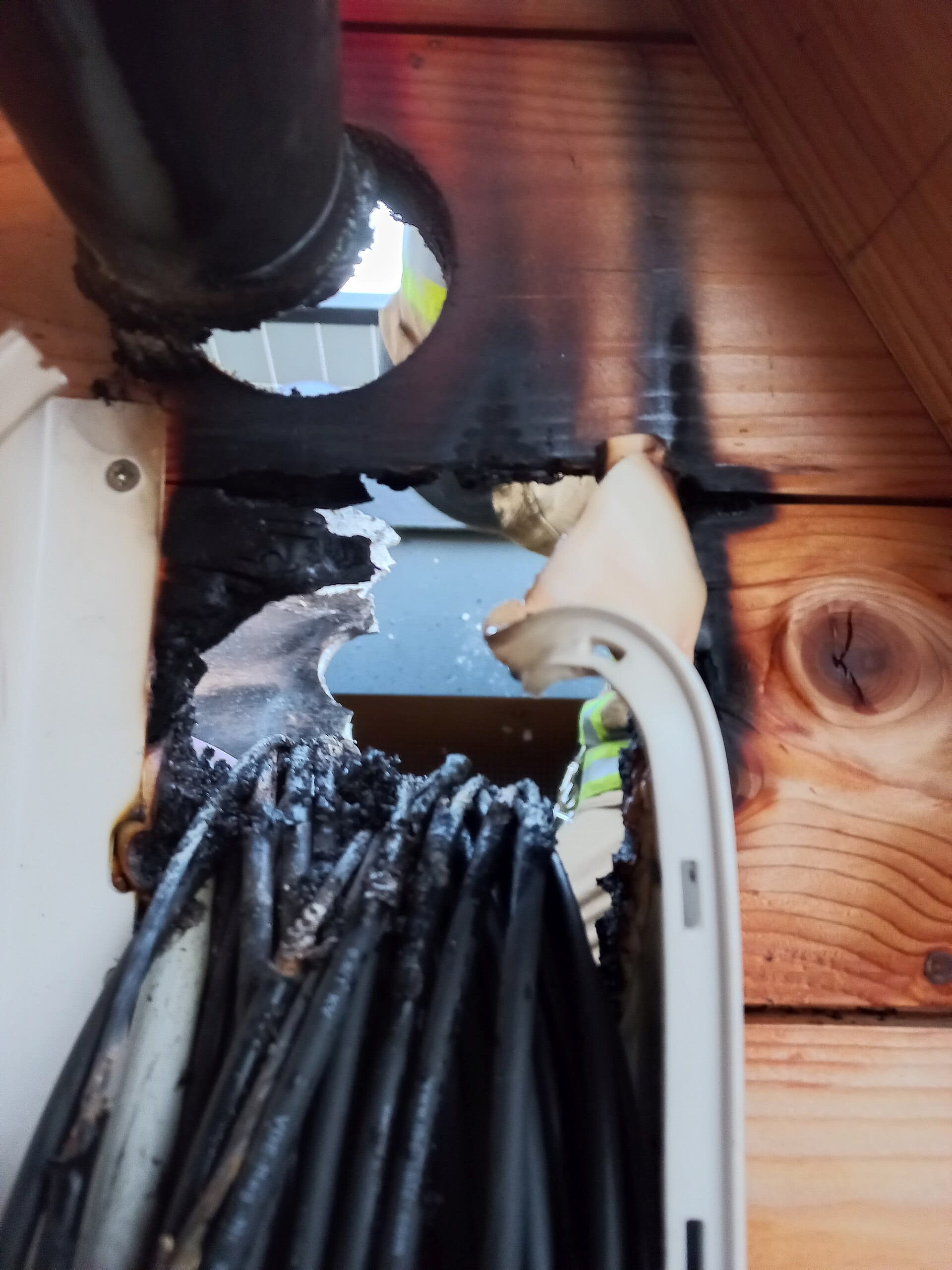
Ask a Nigerian homeowner why they are nervous about solar and you will get the same answer: fire. It is a fair fear, and the one most often sold with exaggeration. Panels do not spontaneously catch fire in the sun. A photovoltaic array cannot produce more current than the light falling on it, so it cannot overload itself. What causes solar fires is a connection, a battery, or a mistake made at installation that nobody found for a year.
That is good news, because connection faults are fixable. Getting solar fire safety right is not about buying an extinguisher and hoping. It is about knowing which four things on a system can start a fire, why each happens in Nigeria in particular, and what you should have insisted on at handover.
Where solar fires actually start
Work backwards from the physics and the answer is narrow. The array is not a heat source in any dangerous sense, so the dangerous places are where power is concentrated or a chemical reaction can run away. That framing is the start of honest solar fire safety.
Ignition points fall into four groups: loose or degraded DC connections, which overheat and eventually arc; the AC side, where inverter output meets household wiring; the battery bank, where one bad cell can escalate; and the roof itself, which does not cause a fire but decides how far one spreads. The last is regularly confused with an ignition cause.
One distinction is worth keeping. Modules do not burn easily: the glass and encapsulant are built to survive the endurance tests in the module safety standards. A fire that destroys a roof usually began in a junction box, a cable run or a battery, and used the array as fuel. If someone says a panel caught fire, ask what set it off.
DC connections and arc faults
This is the mechanism to understand, because it is the most common and the most preventable. An arc fault is a high-power discharge between two conductors that should not be touching. The discharge generates heat, the heat breaks down the cable insulation, and the breakdown lets more current flow, which makes the arc hotter. The reference description of an arc fault names the causes plainly: loose wire connections, overheated conductors, and cable pinched by something.
Why direct current makes this worse is worth one sentence. On the AC side, current reverses direction fifty times a second and an arc tends to extinguish at the zero crossing. On the DC side from the array, current flows one way, the arc is fed continuously, and the power is high. A string of panels has no natural break point, so a small DC fault can sustain itself until a breaker clears or a cable is destroyed. Inside a breaker, the physics is the same positive feedback in a different material: an arc becomes more conductive as it gets hotter, and terminal temperatures can exceed 19,000 degrees Celsius.
Two honest limits. A correctly made connection does not arc. The failure needs a loose terminal, an undersized conductor, an unseated connector, or cable damaged by rodents, ultraviolet light or a sharp edge. Those are installation and maintenance faults, not panel faults. And arc-fault protection is not exotic. The US National Electrical Code requires any PV system on or penetrating a building and operating at 80 volts or more to be protected by a listed arc-fault device. IAEI Magazine sets out that requirement in the context of PV fire and personnel safety. Whether anything equivalent is enforced on your street is a fair question for your installer, which is why the answer is worth asking rather than assuming. The wiring detail is in installation and wiring safety in Nigeria.
Batteries, heat and thermal runaway
The battery bank is where solar fire safety concern is most justified and where the marketing is least honest. A lithium iron phosphate bank that is correctly sized, correctly wired, ventilated and never deeply discharged has a good safety record. A bank crammed into a sealed cupboard, charged by a controller that does not understand the chemistry and left in a compound in April is a different proposition.
The mechanism is thermal runaway: a process that accelerates as temperature rises and releases energy that raises it further. The reference on thermal runaway describes it as uncontrolled positive feedback, notes that lithium-ion cells are particularly prone to it when mishandled, defectively made or damaged, and observes that sealed cells can fail violently if their safety vents are overwhelmed. It also records that iron phosphate and titanate chemistries are safer than the cobalt-based cells in older packs, a real argument for buying on chemistry rather than price per kilowatt-hour. Lithium versus lead acid in Nigeria works through the trade.
Heat here is not a secondary factor. A battery enclosure in direct afternoon sun reaches temperatures nobody modelled in a datasheet. Heat does not cause runaway by itself, but it moves a bank with cell imbalance, a loose connection or a cell at end of life closer to the point where that cell becomes the trigger. Specify shading over the bank, ventilation around it, and a controller with a temperature sensor actually connected rather than dangling unused.
Solar fire safety in the decisions you only make once
Most of what makes a system fire-safe is settled on installation day and expensive to change later, which is the argument for raising it during the quotation.
| Decision | Ignoring it | Getting it right |
|---|---|---|
| Where the battery room goes | Inside a bedroom or a cupboard beside the kitchen | A ventilated, shaded store or garage, never a sleeping room |
| Module fire rating against the roof | Whatever the supplier had in stock | A rating matching or exceeding the roof it is fixed to |
| Gap behind the array | Modules laid flat against the roof | A ventilated gap that lets a hand and a tool get behind the panels |
| Roof access pathway | Every square metre covered | A clear strip so nobody must step on panels to reach the isolator |
| Handover paperwork | A telephone number | A one-line diagram, string layout, fuse sizes and a shutdown procedure |
None of this is expensive if specified at the start. All of it is awkward to retrofit, and none of it improves solar fire safety on its own without sound connections.
Detection and the first ten minutes
Detection deserves realistic expectations. A smoke detector detects smoke, not the chemistry of a lithium cell, but a lithium event produces smoke well before flame, so a detector in a battery store is still worth having. How smoke detectors work is worth reading before you position one, because placement decides whether it hears anything. A battery room also wants a fire blanket within reach and a bucket of dry sand, which works on a small lithium fire and costs almost nothing.
Beyond that, be realistic that you will not be present when this happens. That is why the handover matters more than the equipment. The US Department of Energy keeps a public guide to fire safety with solar systems, written on the premise that properly installed systems by qualified professionals must follow current safety codes while fires nevertheless occur. It covers the questions owners ask: whether rooftop PV puts the home at risk, what causes rooftop solar fires, what hazards face firefighters arriving at a building with live panels, and whether energy storage raises the risk. A Guide to Fire Safety with Solar Systems is the honest document to hand your fire station.
If a fire does start, the first ten minutes are decided by the first two. Switch the system off at the isolator if it is safe to reach, and do not climb onto a wet roof. Call the fire service before attempting anything, and tell them the building has batteries, because that changes the equipment they bring. Do not put water on an energised array, and do not assume a switch removes the hazard: on a sunny day the panels keep producing until the DC side is opened at the array, which is a job for someone who knows what they are doing. Our solar maintenance checklist is where the shutdown procedure should be written down.
Frequently asked questions
Can solar panels start a fire by themselves?
Not from the light hitting them. A module cannot overheat without an electrical fault at its connections. Fires attributed to panels nearly always began in a junction box, cable, isolator or battery, where the panel was fuel rather than the source. A report saying panels caused a fire is a simplification worth questioning.
Are lithium batteries safe to keep inside a house?
A correctly installed bank of a mainstream chemistry, in a ventilated and shaded space, on a charge controller matched to it, is a normal part of many homes. Cramming an unventilated bank into a sealed cupboard, mixing cells of different ages, and ignoring a temperature alarm is not. The chemistry argument and the siting argument are separate, and both have to be satisfied.
Should I fit arc fault protection as a retrofit?
It may already be fitted at the inverter input, which delivers most of the benefit. Ask what was installed and whether it is rated for direct current at the array voltage. If the answer is that nothing is needed because panels are low power, get a second opinion: array voltage is the relevant number, not panel wattage.
Key Takeaways
- Panels cannot spontaneously ignite. Solar fires start at connections, in batteries, or in household wiring on the AC side.
- DC arc faults sustain themselves because current flows one way, so a loose terminal can become a fire rather than a nuisance trip.
- Ask what DC arc and surge protection was fitted, and check the array voltage rather than the panel wattage.
- Thermal runaway is the battery risk worth understanding, and ambient heat moves a marginal bank closer to the edge.
- Specify battery siting, shading, module fire rating and roof access at quotation stage, because retrofitting is expensive.
- Know the shutdown procedure, keep a fire blanket and dry sand near the bank, and tell the fire service there are batteries.
Once the fire questions are settled, protecting the equipment from theft matters just as much, and physical security for inverters, batteries and distribution boards is the natural next read.
Sources: US Department of Energy, A Guide to Fire Safety with Solar Systems; Arc fault, discharge mechanism, insulation breakdown and the common causes; Arc flash, negative incremental resistance and terminal temperatures; Thermal runaway, lithium-ion susceptibility and safer cell chemistries; Smoke detector, detection method and placement; IAEI Magazine, NEC section 690.11 arc-fault protection for PV systems at 80 volts or above.


0 Comments