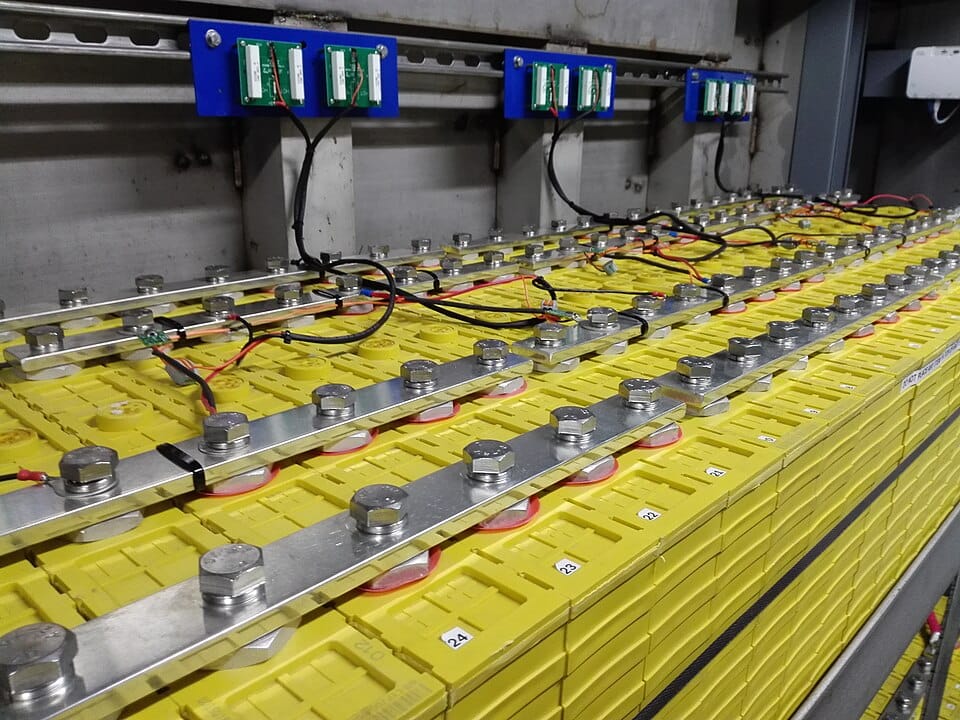
A Nigerian buyer is usually shown a battery marked 5 kWh and told the house will run all night on it. Both halves of that need testing. Solar battery storage is where most off-grid systems quietly underperform, because the number on the case is what the cell holds under laboratory conditions, and the number your sockets see after conversion losses, partial charging and a cautious reserve is considerably smaller. Getting this right is the difference between a system that carries the house through an outage and one that gives up at 11pm.
What solar battery storage has to do
A bank stores energy that has already been collected, because the sun and the evening do not happen at the same time. The array produces over a few hours, the house wants power for eighteen, and the bank bridges the gap. It is the piece of the system that turns a daytime resource into a night-time one, and the design question is how big that gap is for your household rather than for an average one.
There is a second job that is easy to forget. Solar battery storage also has to absorb the moment when the panels produce more than the house draws. With nowhere for the surplus to go, the array output has to be curtailed and energy that was paid for, mounted and connected is thrown away. In an installation with frequent outages that role matters at least as much as the night-time one, because a bank that accepts surplus smoothly is what lets the array run at full output.
| Term | What it means | Why it matters when buying |
|---|---|---|
| Label or nominal capacity | Total energy in the fully charged bank, quoted in kilowatt hours or ampere hours | The optimistic number on the case |
| Usable capacity | What the bank delivers between the charge and reserve limits | The number the autonomy calculation must use |
| Depth of discharge | The share of stored energy taken out per cycle | Shallow cycles extend life, at the cost of a bigger bank |
| Cycle life | How many full charge and discharge cycles the chemistry tolerates | Drives replacement cost, and the real cost per kilowatt hour |
| C-rate | Charge or discharge current relative to capacity | Sets whether the bank can be filled in a rainy week |
Depth of discharge is the number that decides your nights
Depth of discharge, usually shortened to DoD, is the share of the stored charge that a cycle removes, and it is the mirror image of state of charge. It is the most useful number for planning autonomy. Lead–acid deep-cycle cells show an inverse relationship between depth of discharge and the number of cycles they tolerate, and around half is widely treated as the sensible balance between bank life and bank cost. A bank cycled hard every night will still be running when a bank cycled gently has been replaced.
Nobody runs a lead–acid bank to empty, and there is a physical reason. A cell left discharged builds up sulphate crystals on the plates, a condition called double sulphation, and it is largely irreversible. Reserve between a fifth and a third of the bank and you give up a little capacity in exchange for a life measured in years rather than seasons. Set the reserve too small and you have bought the cheapest hardware in the most expensive way. Lithium against lead–acid covers the chemistry difference that changes this.
Lithium changes the arithmetic but does not remove it. State of charge cannot be measured directly in any battery, only estimated, and the estimate drifts as cells age. Extremes of state of charge shorten life in every chemistry, so a lithium bank run constantly between empty and full still ages faster than one held in the middle, just more slowly than lead–acid.
Cycle life and why the warranty figure is not the real one
Cycle life is the number of equivalent full cycles a cell tolerates before it is finished. Published figures are measured at a stated depth of discharge and a stated temperature, and those conditions are almost never the ones your bank will experience. A lithium iron phosphate cell quoted at several thousand cycles was measured in a laboratory. A lead–acid bank is quoted at a few hundred deep cycles, and in a warm compound cycling nightly you will get less than that. Plan the storage budget against the lower figure, not the warranty card.
Temperature is the variable people forget. Bank life is not a number on a warranty card, it is a function of the enclosure, the airflow, the depth of discharge you set and the hours the bank spends at a high state of charge. A sealed battery in a hot, unventilated cabinet in July will die sooner than the same battery in a shaded, ventilated one, which is why the same nominal bank in the same compound produces such different reports about solar battery storage life.
C-rate: can your bank actually be filled?
The C-rate expresses charge or discharge current as a fraction of capacity. A 500 ampere hour cell discharged at 500 amperes is at 10C, and the same cell charged at 250 amperes is at C/2. The reason it appears in every lithium datasheet is that current makes heat, roughly in proportion to the current involved, and heat is what shortens life.
The practical consequence is a rainy week. If your array is 2 kWp and your bank is 10 kWh, you are asking the bank to absorb whatever the panels throw at it on a good day, a high C-rate, and then to deliver your evening load on top of that. A bank rated only for a slow C/10 will refuse, and the inverter will sit in absorption or stop charging. During a long stretch of cloud that is the difference between topping storage up and watching it drift down for a week. Ask for the maximum charge current, not just the capacity.
Label capacity against usable storage
Here is where the marketing does its work. A bank sold as 5 kWh is 5 kWh of cells. What reaches the house is that figure multiplied by the discharge efficiency of the bank, by the inverter conversion efficiency and by the share you have reserved, then subject to what the cells deliver at the end of a discharge rather than the middle, because battery voltage sags under load. Do the working: take off the reserve, then the conversion losses, and divide what remains by your evening load. If a supplier resists showing you the calculation, that is your answer.
Choosing between lead-acid and lithium
Where each one genuinely wins
Lead–acid is cheaper per kilowatt hour installed, needs no management system, and is easy for a small installer to source. Its weaknesses are weight, low energy density and a short cycle life. It comes as flooded, where the electrolyte level must be checked and water added, or as a valve-regulated sealed unit, of which the absorbed glass mat and gel types are the common forms. Sealed units are the sensible default in a home, because a flooded bank is a maintenance commitment you must keep for a decade.
Lithium iron phosphate is lighter, needs no watering, tolerates deep discharge without the same penalty and has a far longer cycle life. It costs a management system, a colder charge requirement in some designs, and energy density still below the best nickel-based chemistries. Lead–acid wins on price per kilowatt hour and on local availability; lithium wins on lifetime, weight and how much usable storage you get for a given footprint. Our maintenance guidance is in the solar system maintenance checklist.
Frequently asked questions
How many batteries do I need to run the house for one night?
Work from your evening load in watt hours, not from a count of batteries. Take the label capacity, remove the reserve, then divide what is left by your evening load after conversion losses. A household using 4 kWh after sunset needs a bank well above 5 kWh to reach sunrise, which is where most disappointing first installations come from. Battery bank sizing works through an example.
Is a bigger bank always better?
No, and this surprises people. A larger bank does not produce more energy, it stores more of what the array already collects, so a bank larger than the array can refill is money sitting still. Its value is resilience through a bad week, and the freedom to hold a high reserve.
Why does my bank show full but the lights still dim?
Most often the inverter has reached its absorption stage and the bank is on float, so the remaining charge is arriving slowly and the unit is deliberately holding back. This is normal in the middle of a sunny day, and it is also what happens when the charge controller is too small, or when the array voltage sits too close to the bank voltage for a controller to do much, which is the subject of PWM against MPPT charge controllers.
Can I mix old and new batteries in one bank?
Do not, and the reason is physical rather than administrative. Cells in a series string share the charge, so a new cell in a bank of tired ones is pushed past its limits trying to match them while the tired cells drag the new ones down. Replace the bank, or fit a second bank with its own controller.
Key Takeaways
- Plan solar battery storage from usable capacity, not from the label on the case.
- Storage sizing is an evening-load calculation, and a bank that is too small fails at 11pm.
- Depth of discharge drives both how many nights you get and how long the bank lasts; half is a reasonable lead–acid target.
- Cycle life figures assume a controlled temperature and depth, which a compound will not provide.
- Check the maximum charge current, which decides whether storage refills after a week of cloud.
- Keep a reserve. Held off empty, a bank is the cheapest part of the whole installation.
- Do not mix old and new cells in one series string, whatever a supplier tells you.
The bank is only half the sizing problem, and how to size a solar inverter and battery bank deals with the unit that has to charge and discharge it.
Sources:
deep-cycle batteries, the depth of discharge and cycle life trade-off, and the flooded and sealed variants; lead–acid batteries, energy density, sulphation in the discharged state and deep cycle count; lithium iron phosphate cells, cycle life, cell voltage and specific energy; state of charge, depth of discharge and why neither is measured directly; C-rate, how charge and discharge currents relate to capacity, and the heat they produce.


0 Comments