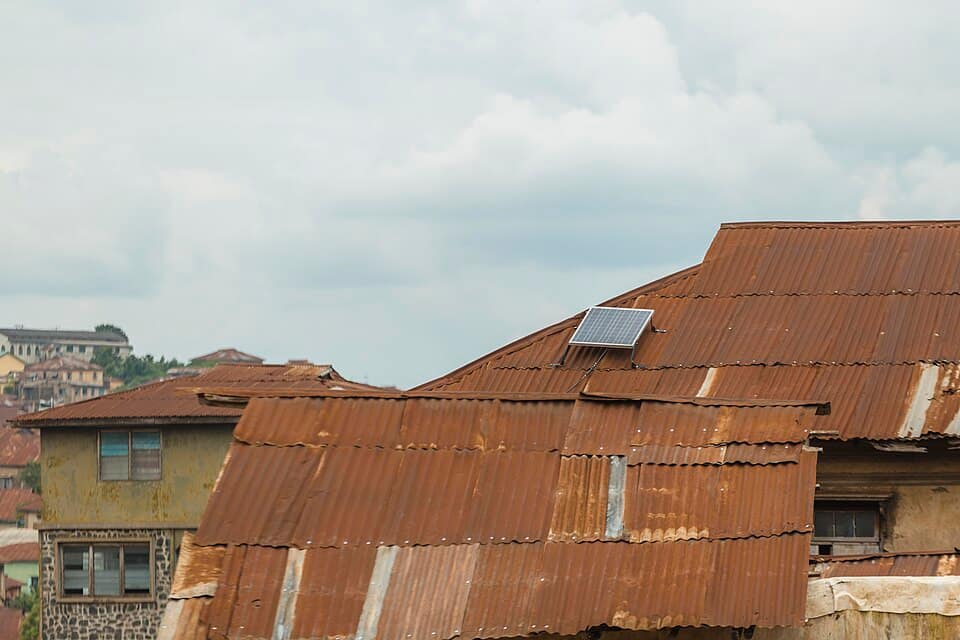
Ask an installer how a system performs in June and you will get a confident answer that nobody has measured. The honest version is that it depends on where you are, and the difference between a dry-month figure and a wet-season figure is large enough to decide whether the system needs a bigger array. Solar in the rainy season is not a different technology. It is the same panels under a different sky, and the change is measurable rather than mysterious.
What solar in the rainy season actually looks like
The numbers below are not a vendor promise. They are modelled figures for four Nigerian cities from the European Commission PVGIS tool, which builds a satellite-derived picture of the solar resource for a site with a standard 14 per cent system loss applied. That allowance already covers an element of soiling, mismatch and cabling, so these are what a well-kept system should roughly achieve, not a laboratory maximum.
Read the seasonal column, not the annual one. The annual figures hide the effect, because a very good dry month compensates for a poor wet one. What a household actually experiences is the month-to-month swing.
| Location | Average daily sun, Jan to May and Sep to Dec | Average daily sun, Jun to Aug | Drop in the wet months | Modelled yield per kWp per year |
|---|---|---|---|---|
| Abuja | about 6.0 hours | about 4.6 hours | roughly 24 per cent | about 1,500 kWh |
| Kano | about 6.5 hours | about 5.9 hours | roughly 9 per cent | about 1,700 kWh |
| Lagos | about 5.6 hours | about 4.5 hours | roughly 20 per cent | about 1,460 kWh |
| Port Harcourt | about 5.0 hours | about 3.8 hours | roughly 24 per cent | about 1,260 kWh |
Two things stand out. The southern drop is larger than the northern one, because the southern rains are longer and arrive with the cloud of the intertropical convergence zone sitting over the country, while the northern wet season is shorter and clearer. And Port Harcourt, where the wet months drop below four hours a day. A system there sized on a dry-month reading will disappoint badly between June and August, and no inverter adjustment fixes it, because the light is not there. The maps behind these figures are in Nigeria solar energy potential.
Why cloud does not switch a panel off
There is a persistent myth that a cloudy day means zero output, and it leads to badly sized arrays. Cloud attenuates the direct beam and scatters what remains, so a panel under thick cloud receives less light overall, but a larger share arrives from the whole sky rather than from one point. A panel still generates, at a reduced level, and the reduction depends on the cloud rather than on a fixed fraction anyone can quote for your roof.
The consequence for design is that the production profile changes shape rather than disappearing. A clear day has a steep curve, rising quickly after sunrise, peaking near solar noon and falling away. A wet-season day has a flatter, wider curve, with less at noon and more at either end. A bank sized for the clear-day peak will be under-used in the wet months, and a system judged by a single mid-day reading in August will look like a fault when it is behaving normally.
The one thing the rain helps with
Crystalline silicon cells lose output as their temperature rises, which is why a panel in full sun in a hot compound produces less than its nameplate figure even at full irradiance. A wet season is cooler, so that part of the loss is smaller. It recovers a fraction of what the cloud took, and it does not come close to compensating. Any supplier who points at cooler weather to justify a smaller array is misleading you.
Rain also does the maintenance work for you. As the figures above show, locations with frequent rain can carry a soiling loss below 1 per cent, and a surface rinsed regularly needs less cleaning than one that bakes through three months of Harmattan dust. That is a genuine benefit, and the only one that shows up in the bank balance rather than in the generation figures.
Storms, water and the real risks
Output is the visible problem. The damage risk is the one that costs money. A Nigerian wet season brings wind gusts, water entry points and lightning, and each attacks a different part of the installation. Wind works on the mounting, not the panels, which are heavy and flat, so a badly fixed frame can lift a bracket long before any panel is damaged. Check every fixing after the first serious blow.
Water attacks the connections. Cable entries into junction boxes, the connectors between panels, and any conduit cut and rejoined are the places to inspect after the rains, not the glass. A connector pushed together slightly less than fully will arc, heat and eventually fail, and it does so more often in a wet season because the air around it is damp. A burnt smell from an enclosure is an emergency, not a curiosity.
Lightning is a risk to the electronics rather than the panels, and it argues for the surge protection and earthing discussed in solar installation wiring and safety. On an exposed site this is one of the few places in a solar budget where spending more genuinely reduces the risk of losing the whole system.
Planning for the months that are not sunny
Size on the worst month, not the average year, and treat the wet months as the design case. The method is simple: decide how many kilowatt hours you need through a bad stretch, divide by the sun hours you can count on in that stretch, and work backwards to array and bank size. The arithmetic is in how many solar panels you need and battery bank sizing.
There is a judgement call here that people get wrong. A larger array does not fix a short wet season, because the light is missing, and only storage bridges a genuinely dark week. The productive question is not how much more panel to buy, it is how much more bank, and how much of it you keep in reserve. Where the connection is unreliable at the same time, the arithmetic is harsher, because the grid cannot be relied on to cover the gap. Solar against generator is the fair comparison.
One practical warning. A large share of Nigerian systems are commissioned at the start of the rains, so the owner first experience is the worst month. Judge a new installation on a clear-day production figure at a known time, and on the bank reaching a sensible state of charge by late afternoon, not on a June reading.
Maintenance and cleaning in wet conditions
Two rules cover most of it. Do not go onto a wet roof, because that is where the injuries happen, and a break in the rain is always available. And do not treat light rain as a substitute for cleaning, because a shower wets the surface without shifting the film that has built since the last dry spell.
What the wet season adds is inspection. Walk the array from the ground with binoculars if it is not safely reachable, and look for a panel producing noticeably less than its neighbours on a clear day, which is a string, connection or soiling problem rather than a weather one. Check for corrosion on exposed steelwork and frame fixings, because a surface wet for weeks shows it at the fasteners first. The routine is in the solar system maintenance checklist.
Frequently asked questions
Do solar panels still work on a cloudy day?
Yes, at reduced output. Cloud reduces the direct beam and scatters what is left, so the panel receives less light overall, but a thick overcast sky still delivers usable energy and it is rarely nothing. The daily curve also flattens, so production spreads more evenly across the day. The size of the reduction depends on the cloud, which is why anyone quoting a single percentage for cloudy output in your area is guessing.
Which months are the worst for solar in Nigeria?
Roughly June to August in the south, where the drop against the rest of the year is around a fifth to a quarter, and a shorter window in the north where the drop is closer to a tenth. The pattern moves year to year with the position of the rain belt, and a single dry week in August can change a monthly average without meaning anything. Use the seasonal averages to plan and the actual sky to interpret a bad month.
Does rain damage solar panels?
Rain itself does not, because the modules are sealed and designed for outdoors. What damages a system in the wet season is the wind that arrives with the storm, which works on the mounting, and moisture that reaches a connection or a cut cable, causing arcing and corrosion. Inspect fixings after a serious blow and check connectors for heat or discolouration. Panels also get harder to reach safely, which is the more common practical problem.
Should I install solar at the start of the rainy season?
Install when you are ready, but do not judge the result then. A system commissioned in June will look weak for weeks, and the temptation is to blame the installer for weather. Ask for a modelled monthly production figure for your location, keep a note of clear-day readings once the sun returns, and compare the two.
Key Takeaways
- The wet-season drop is measurable: roughly 9 per cent in Kano, 20 per cent in Lagos, and about 24 per cent in Abuja and Port Harcourt, on modelled figures.
- Solar in the rainy season is a flatter, weaker version of a clear day, not an absence of output.
- Cooler cells recover only a fraction of what the cloud took, so a smaller array is not a saving.
- Storage, not more panel, bridges a genuinely dark week.
- Wet-season damage shows up in mounting fixings and connectors, not in the panels, and both are worth inspecting after a storm.
- Never climb a wet roof, and never treat light rain as a substitute for cleaning.
Before commissioning anything, the resource for your own street is worth checking against the figures above, and how many solar panels you need turns them into a number.
Sources:
PVGIS, the European Commission photovoltaic yield calculator used for the monthly figures quoted here; Global Solar Atlas, satellite-derived solar resource and photovoltaic yield by location; the intertropical convergence zone, and why cloud follows the rain belt across West Africa; soiling losses and why regions with frequent rain carry a smaller soiling loss; solar panel construction, sealing and behaviour under changing irradiance.


0 Comments