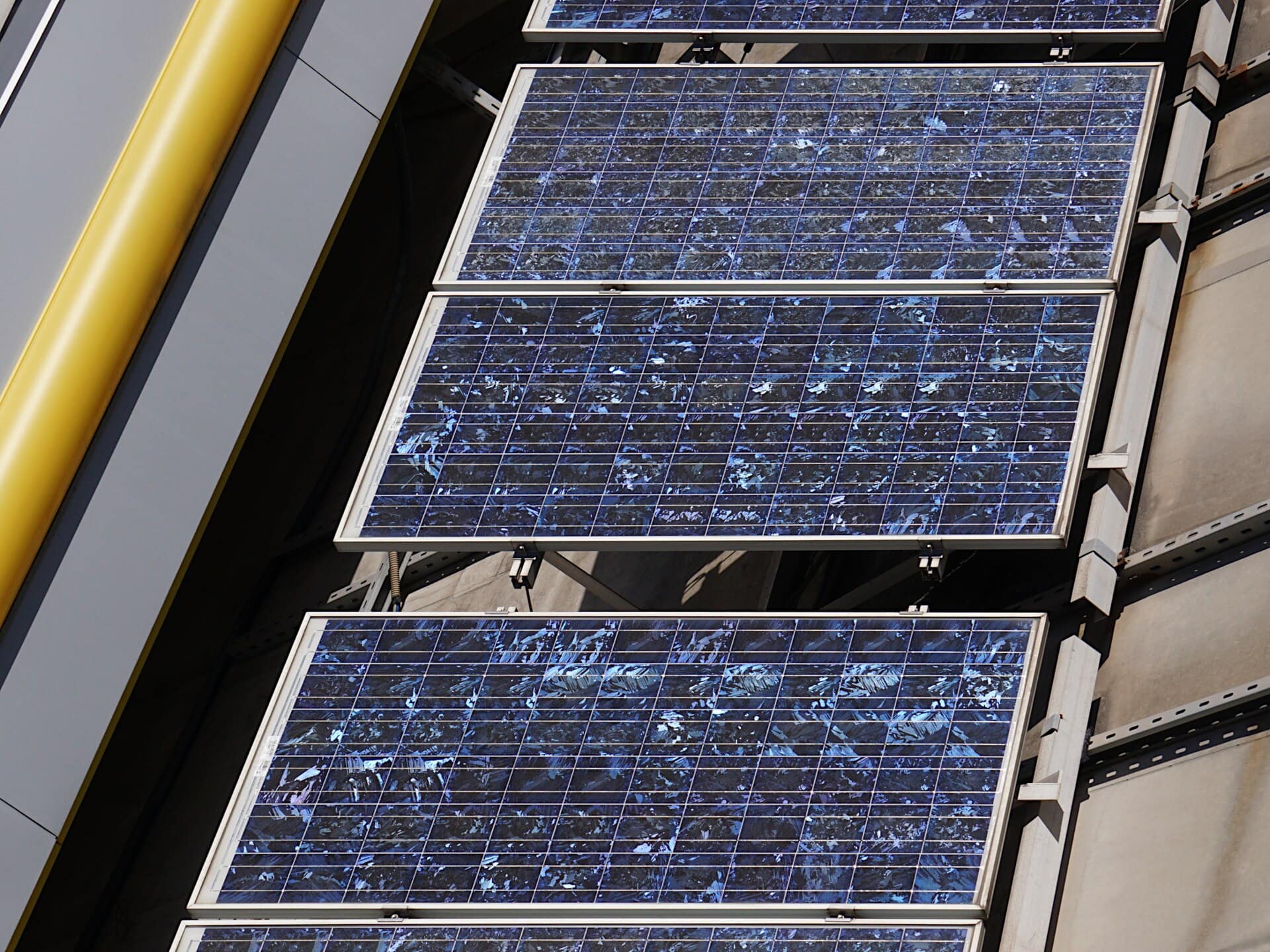
Two panels get quoted to the same customer on the same afternoon. Both are 450 watts, both carry a printed warranty, and one is uniformly black while the other is blue and speckled. The installer points at the black one and says it is better. Usually true, but rarely for the reason given, and the difference that actually matters in Lagos, Abuja or Kano is not the one on the brochure. This is the poly vs mono question, and it deserves a proper answer.
A poly vs mono comparison written ten years ago is already out of date. Modern mono cells are not simply better panels, and they are what the factory output has become. The live question today is space, and whether you are being sold honest numbers.
What poly vs mono actually means in the factory
Both are crystalline silicon. The difference is the grain structure of the wafer, and everything else follows from it. Poly, properly called multicrystalline, is made by melting high-purity silicon and casting it into a block. On cooling it solidifies as many small crystals growing against each other. Those boundaries, called grain boundaries, are where electrical losses live, because a charge carrier meets a defect at every boundary it crosses.
Mono is grown as a single crystal, most often by the Czochralski process, where a seed is drawn slowly out of a melt of very pure silicon. There are no grain boundaries, the lattice is continuous, and the cell converts more of the light landing on it. It also absorbs light better, which is why a mono cell looks black and a poly cell looks blue: the blue is light that passed through or reflected off the material instead of being absorbed.
The efficiency difference is real but not enormous. Recorded laboratory single-junction cell efficiency is quoted at 26.7 per cent for monocrystalline silicon against 22.3 per cent for polycrystalline, and polycrystalline modules typically sit in the 14 to 18 per cent range. Those are laboratory figures, but the ordering holds in the field.
Efficiency and the space it saves you
For a homeowner the only thing efficiency buys is area. A mono array needs fewer square metres for the same kilowatt peak, which matters when the roof is small, the building has an awkward shape, or the array must fit between a water tank and a parapet. If you have space to spare, efficiency is worth very little, and paying a premium per watt for it is a poor trade.
| Consideration | Poly module | Mono module |
|---|---|---|
| Appearance | Blue, speckled, visibly crystalline | Uniform black or very dark grey |
| Module efficiency quoted | About 14 to 18 per cent | About 19 to 23 per cent on current builds |
| Area needed for the same output | Larger | Smaller |
| Behaviour in heat | Falls as cell temperature rises | Falls as cell temperature rises, by a similar margin |
| Early-life output loss | Usually smaller | Usually slightly larger |
| Long-term degradation | Marginally slower in field data | Marginally faster in field data |
| Availability in Nigeria | Common, increasingly the budget option | The default choice of most factories |
| Price per panel | Lower | Higher |
| Price per square metre | Higher | Lower |
Read the last two rows together, because they are the whole commercial argument. A mono panel costs more per panel and produces more watts in less space. If the site is roof-constrained, mono is the cheaper answer per square metre. If the array goes on open ground, poly is defensible and the difference is better spent on the battery bank, which delivers more usable energy at night than a few extra points of panel efficiency ever will.
Which one lasts longer
This is where marketing usually gets it wrong. The claim that mono lasts longer and poly fades first is not supported by field data. The long-running United States Department of Energy programme that measures real modules, removing them from the field once or twice a year for an accurate reading, found a mono PERC module losing about 0.4 per cent a year and a multi PERC module losing about 0.3 per cent a year, most of it in year one. The gap is small and it runs against the claim, not for it.
What decides survival is build quality and installation, not wafer structure. Ask about the glass, the frame, the junction box rating, the number of bypass diodes, the connector type, and whether the module is certified to IEC 61215 for performance and IEC 61730 for safety. Then ask what the warranty document commits the supplier to, and who honours it here. solar panel warranty terms explained covers what the fine print really commits anyone to.
For the rate at which output falls over the years, solar panel degradation covers the annual figure, the first-year drop, and the difference between what the label promises and what the roof produces.
What Nigerian heat does to both of them
Heat is the real enemy, and heat does not care whether the wafer is one crystal or many. Panel power falls as cell temperature rises, described in the datasheet as a temperature coefficient, a percentage per degree Celsius. On a typical coefficient of about minus 0.35 per cent per degree, a cell running forty-five degrees above the twenty-five degree test temperature gives up close to sixteen per cent of its rated output. That is not a small effect in April, and it applies to poly and mono alike.
So never judge an array from a hot midday reading and call it faulty. A panel twenty per cent below its label on the hottest day is behaving normally. The related trap runs the other way: because voltage falls less than current does, a hot string still pushes a high open-circuit voltage at dawn, which is the constraint the charge controller must survive. How to read a solar panel datasheet covers how to make that check instead of guessing at it.
Availability, cost and the import reality
Crystalline silicon accounted for about ninety-five per cent of worldwide photovoltaic production in 2021, and within that, mono has been the dominant technology since around 2018, with the price gap narrowing rather than widening. In Nigeria that means mono is what you will be offered and what distributors hold, and a poly array quoted today is a deliberate budget choice rather than old stock. Import duty, port handling, clearing charges and the exchange rate all feed the landed cost, and a panel that got dearer at the border is still a good panel that simply cost you more money.
What is a bad panel is one that is not the wattage it claims. Mislabelled and counterfeit modules are a real problem in markets where stock arrives by the container and sells quickly. Ask for the datasheet and the certification, check the model number on the label against the certificate, and have the array tested and witnessed before acceptance. how to choose a solar installer in Nigeria sets out what to ask for on paper before anyone starts drilling.
The honest recommendation
If the roof is small or oddly shaped, buy mono. The space you save is worth more than the money you spend, because the alternative is a bigger array you cannot fit, and a system you cannot fit produces nothing. If the array goes on open ground, on a shop roof with plenty of run, or on a larger commercial building, poly is a legitimate way to spend less on panels and put the difference into storage.
What is not legitimate is being told that one technology lasts decades longer, that mono runs cool in the sun, or that poly is obsolete rubbish. All three are marketing. The real differences are a modest efficiency gap, a small and often reversed degradation gap, and a decision about space and price.
Frequently asked questions
Are poly solar panels cheaper in Nigeria right now?
Usually yes per panel, and usually not per square metre, which is the number that matters on a tight roof. Poly is now a deliberate budget option rather than leftover stock, because factories have moved to mono. Compare total installed cost for the same kilowatt peak, including mounting, not the panel price alone. A cheaper panel needing more area, more steel and more cable has usually saved nothing.
Do mono solar panels get too hot in the sun?
No more than poly, and the difference is negligible. All crystalline silicon modules lose power as cell temperature rises, usually by around a third of a per cent per degree. A hot day costs you output whichever type you installed. Managing that loss is a mounting and ventilation problem, not a wafer problem, and it is identical across both technologies.
Which type is easier to replace in Nigeria?
Mono, by a wide margin, because that is what factories have shipped for years and what distributors here stock. If you may add panels later, matching the type and model already on the roof ends the argument on its own.
Does panel type change the charge controller I need?
Not by itself. What decides the controller is string voltage and current, bank voltage, and whether you want a maximising tracker. A mono panel of the same wattage often has a higher voltage and a lower current than a poly panel, which changes the string design rather than the equipment category. Work from the datasheet voltage and current, not the wattage.
Key Takeaways
- Poly and mono are both crystalline silicon. Mono converts light better because it has no grain boundaries.
- Mono costs more per panel and usually less per square metre, so the decision is about space, not quality.
- Field data does not support the claim that mono lasts longer. Multi PERC has degraded slightly more slowly.
- Heat is the biggest real output loss here, and it hits poly and mono almost equally.
- Both types can be excellent and both can be mislabelled. Certification and an acceptance test protect you.
- Put spare budget into the battery bank rather than the last few per cent of panel efficiency.
Once the panel type is settled, the numbers that decide the rest of the design are in how many solar panels you need, and the module design details are in half-cut solar cells.
Sources: monocrystalline silicon, cell efficiency figures, the shift in market share since 2018 and the narrowing price gap; polycrystalline silicon, module efficiency range and the manufacturing route; PV Lifetime project annual report, measured degradation of mono and multi PERC modules in the field; solar panel technology, temperature coefficients and the IEC module standards.


0 Comments