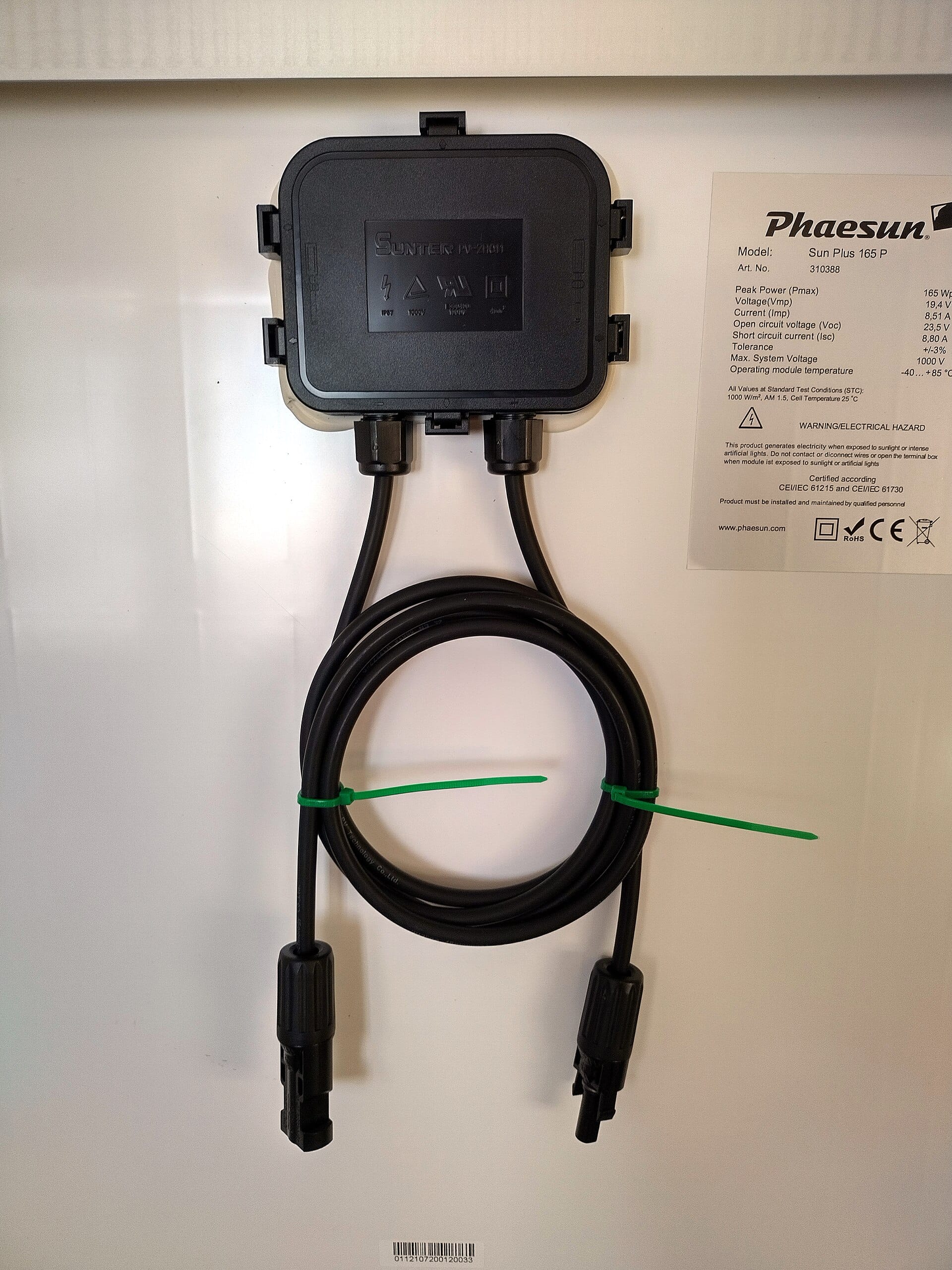
A 25-year warranty is printed on the box of almost every panel sold in Nigeria, and on a surprising number it means almost nothing. It might promise something about the sheet metal, something about power output, or something so tight that no panel could ever fail it. All three documents are called a solar panel warranty, and telling them apart takes ten minutes.
It matters more here than in markets with a working retail warranty system. When a module fails in year nine, the practical question is not the small print, it is who answers the phone and whether the brand is still trading. The paperwork has to be read before the money is spent.
The two sides of a solar panel warranty
Every reputable module has two separate documents and they are frequently confused. The product warranty covers manufacturing defects: delamination, corrosion of the frame, a junction box that fails, a seal that lets water in, cells that crack in the laminate. The performance warranty, usually called a power output warranty, covers the electrical side: it promises that after a stated number of years, the module will still deliver a stated percentage of its rated power.
| Feature | Product warranty | Performance warranty |
|---|---|---|
| What it covers | Defects in materials and workmanship | Output falling below a stated percentage |
| Typical length offered | Five to twenty-five years | Twenty-five to thirty years |
| What triggers a claim | A recognised defect, or a defined failure rate | Measured power below the curve |
| How it is settled | Repair or replacement of the module | Repair or replacement, sometimes pro-rated |
| Who writes it | Usually the module manufacturer | Usually the module manufacturer |
| Key weakness | Undefined terms, and dispute over the cause | Measurement conditions and the reference figure |
A twenty-five year product warranty is commercially normal. A twenty-five year performance warranty is the valuable one, because manufacturing defects usually show up in the first two years and then stop, while slow output decline is the thing that actually reduces your yield in year fifteen. solar panel degradation covers what that decline looks like in real field data.
Reading the degradation curve
The performance warranty contains a graph. The horizontal axis is years, the vertical axis is retained power as a percentage. A typical curve starts at one hundred per cent and steps down: above ninety per cent in year one, above ninety-five per cent for ten years, then around eighty-five or ninety per cent at twenty-five, often with a final point in the thirties. The step down in the first year is deliberate, because every module loses that much on light exposure, and a curve with no first-year step is a company hoping nobody measures.
Three questions decide whether the curve is worth anything. What is the reference figure, the nameplate rating or the measured output at commissioning? What measurement conditions are allowed, and does the company accept a portable device with an irradiance reference? And what is the remedy, full replacement, pro-rated replacement, a repair, or a credit?
Compare that with the field data and the value of a tight warranty becomes obvious. The long-running United States Department of Energy programme measures real modules year after year, with typical change around minus 0.4 per cent a year for mono PERC and minus 0.3 for multi PERC, most of it early. Evaluated against a common warranty threshold of better than minus 0.8 per cent a year, that data projects a meaningful minority of systems falling outside a typical floor and qualifying for replacement. Claims are not a theoretical exercise.
The measurement conditions that void claims
This is where warranties die, and it is not usually dishonest, it is procedural. A performance warranty is written around standard test conditions: irradiance of one thousand watts per square metre and a cell temperature of twenty-five degrees. A panel on a roof in Nigeria at midday in April has a cell around sixty degrees, is producing less than its rating, and has not failed. If the company measures naively, the array looks degraded. If it measures correctly, it looks normal.
So the question to ask the supplier is simple: how is output measured for a claim, and will you accept a corrected on-site reading? A company with a credible warranty answers that on the first call. A company that requires the panel to be shipped to a laboratory facility of its own choosing is telling you the claim is a theoretical right rather than a practical one.
Other conditions that void claims are mundane and worth knowing. The module must not have been installed outside the stated voltage and temperature range, which is where a badly designed string will eventually land you. It must not be mechanically damaged, and a walk-on installer who stepped on a panel has given the insurer a reason. It must not be connected to equipment the manufacturer did not approve, and it must be maintained, which usually means a module with a visible layer of cement dust and bird droppings is not going to win an argument about its own degradation.
What to check before you pay
Ask for the warranty document itself, not the summary. A summary on a quotation is advertising; a document with registration terms, a claims address and defined remedies is a contract. If the supplier cannot produce the document for the exact model they are quoting, walk away, because the module they install will not be the module on the paperwork.
Then check the certifications, the part of the quality story that is objectively checkable. The reference standards for crystalline silicon modules are IEC 61215 for performance and design qualification and IEC 61730 for safety, with IEC 61853 covering module performance testing and energy rating. A module carrying those, with the label model matching the certificate, is a real product. A module with a smooth featureless label is not.
Finally, ask the question that matters most in this market: who enforces the warranty locally. Is there a Nigerian entity named in the document, or is the claim address an email in another country? International claims departments do not fly out to inspect an array, and a warranty with no local path to a remedy is worth roughly what it costs to ignore.
How to make a claim
Keep the paperwork from day one: the invoice, the datasheet for the exact model, the serial numbers, the commissioning test with the measured output, the photographs of the array, and the warranty document itself. A claim without the commissioning figure is a claim against the nameplate, which is a much harder argument.
Then measure properly before you call anyone. A current-voltage meter, a reference device such as a calibrated irradiance meter, and a rule of thumb on the expected output for the irradiance and temperature will tell you whether you have a real problem. If output is down sharply on some panels but not others, that is a fault on those panels. If everything is down equally, suspect soiling, shading, a battery-side problem or an expectation set too high before you accuse the modules. solar panel cleaning in Nigeria is the first cheap test, and monitoring that reports per-string output is what turns a suspicion into evidence.
Put the claim in writing, reference the warranty document and the model numbers, attach the commissioning data and the current measurement, and ask for the remedy the document specifies. Keep copies. If the response is a counter-offer, that is normal commercial behaviour, not a dead end.
Frequently asked questions
What does a 25-year solar panel warranty actually cover?
Usually only manufacturing defects, unless you are also given a separate performance warranty. A twenty-five year figure on a product warranty is normal and often covers frames, laminate, junction boxes and seals. The output promise lives in a different document, and that is the one to look for and the one to interrogate on measurement conditions.
Are cheap panels with long warranties a bad deal?
A long warranty on a panel nobody has heard of is cheap for the supplier to give and hard for you to use. Judge the brand on whether the certificate is real, whether the model on the label matches the certificate, whether the performance warranty has a defined reference figure and remedy, and whether there is a route to a claim from Nigeria. Four yes answers beat a glossy certificate.
Do I need extended warranty cover on top of the panel warranty?
Only if your installer offers something that genuinely adds to it, for example paying someone to remove, transport and refit the module, or cover for a whole string rather than one panel. Many extended policies simply reimburse the maker’s warranty and add a fee. Ask what is covered that the module warranty does not, and who pays for the work.
Can a solar panel warranty be transferred with the property?
Many require the original purchaser to make the claim, and some allow transfer with proof of purchase. If you might sell the building, ask in writing before you buy, and keep the invoices and serial numbers together in a file that will survive your own memory. A warranty that cannot be transferred after twenty years is worth less than one that can.
Key Takeaways
- Product warranty and performance warranty are different documents, and only the second one protects your output.
- The curve is a floor, not a forecast, and the reference figure decides how strict it is.
- Measurement conditions void most claims, so ask how output will be measured and whether a corrected on-site reading is accepted.
- IEC 61215 for performance and IEC 61730 for safety are the standards to see on the certificate.
- Keep commissioning output, serial numbers and invoices, because a claim without them is a claim against the nameplate.
- A warranty with no local route to a remedy is worth very little, so establish who answers the phone before you pay.
The modules themselves are covered in poly vs mono solar panels, and choosing a supplier who will be there in year ten is covered in choosing a solar installer in Nigeria.
Sources: solar panel standards, including IEC 61215 for crystalline silicon performance, IEC 61730 for safety and IEC 61853 for performance testing; warranty as a contractual promise and the difference between express and implied terms; PV Lifetime project annual report, measured module degradation rates, nameplate versus measured performance and the share of systems projected to reach warranty limits; solar cell construction and the effect of shading and defects on output.


0 Comments